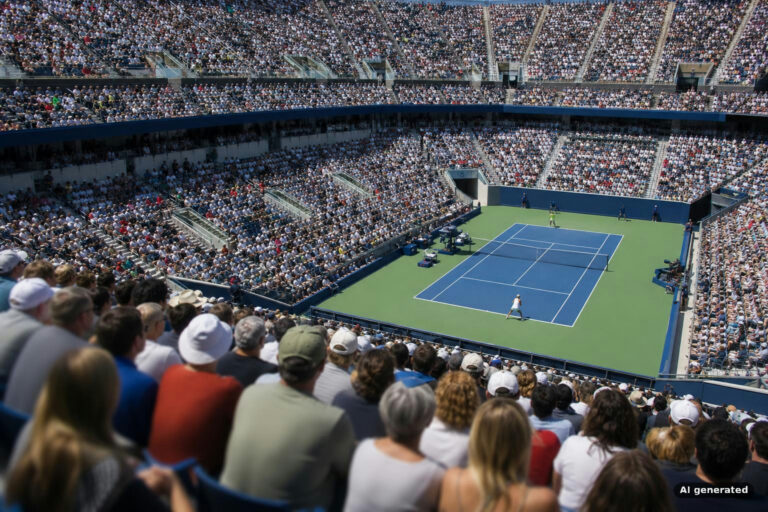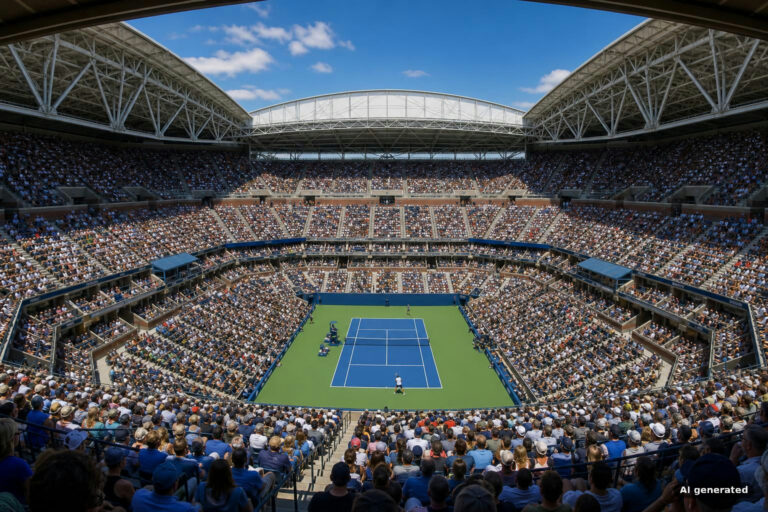
Timofey Dmitriyevich Skatov advanced to the final of the ATP event in Shanghai with a 6:3, 6:2 semifinal victory over Stefanos Sakellaridis. The Kazakh controlled proceedings on the hard court for long stretches, producing a focused display to book his place in the title match.
Skatov takes early command
Skatov was alert from the outset, pushing Stefanos Sakellaridis into extended rallies right from the start. The Greek found occasional solutions but could not sustainably withstand the pressure Skatov applied from the baseline. The Kazakh played with clear intent and capitalised on his chances more consistently whenever openings appeared on return.
The first set went to Timofey Dmitriyevich Skatov 6:3, with his stability on serve proving decisive. He landed 68 per cent of his first serves and won 74 per cent of those points. That forced Sakellaridis into a largely defensive role, leaving him with little room to generate pressure of his own.
A commanding second set
Skatov remained the dominant force after the changeover. Stefanos Sakellaridis tried to take the rallies on earlier but introduced more unforced errors in the process. Skatov stayed patient, kept tight to the baseline and waited for the moment to close out exchanges with a winner.
The second set went to Skatov 6:2. The Kazakh won 71 per cent of games overall and was significantly more effective on return than his opponent. He was particularly dangerous against the Greek's second serve, winning 57 per cent of those return points.
Statistics underline Skatov's superiority
The match statistics confirmed the one-sided nature of the contest. Skatov won 58 per cent of total points and conceded very few openings on his own serve, holding in 89 per cent of his service games and effectively forcing Sakellaridis to earn almost every game through his return.
Skatov also had the edge in unforced errors, committing 16 to Sakellaridis's 28. The Greek struck five aces, but Skatov countered with a controlled serving display of his own, needing only one ace to keep his service games largely secure.
At the net, Skatov won half of his points there — reflecting his willingness to finish rallies away from the baseline. Sakellaridis converted 39 per cent of his net approaches and found the right moment to come forward far too rarely overall.
A significant result for both players
For Skatov, the win was a compelling step forward in the tournament. The 25-year-old right-hander from Kazakhstan, who plays a two-handed backhand, delivered a mature and well-structured performance. He initially represented Russia as a junior before switching to the Kazakh federation in 2018. He is currently the country's third-ranked player, with a career-best singles ranking of 123 in the ATP standings.
Sakellaridis, meanwhile, suffered another heavy defeat, though he can point to a recent career-best ranking of 134. The 1.98-metre-tall Greek is currently his nation's second-ranked player and was seeded 20 in Shanghai. Against Skatov, however, he lacked the consistency throughout the match to sustain any meaningful response to the pressure he faced.
Timofey Dmitriyevich Skatov thus sealed his place as the semifinal's winner. On the Shanghai hard courts, the Kazakh had dominated with his serve, remained efficient on return, and rarely allowed Stefanos Sakellaridis to escape his tactical grip.