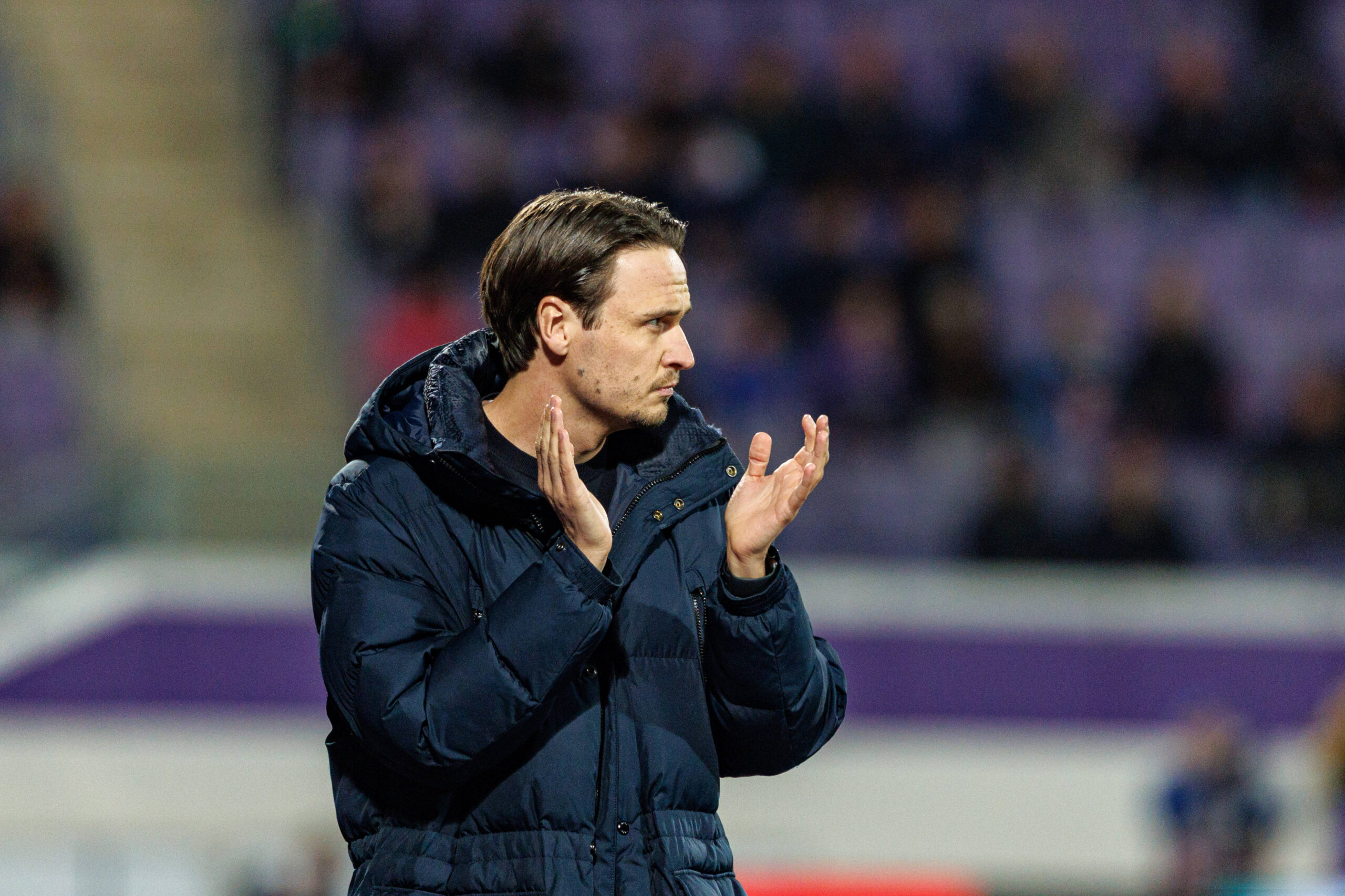
Austria Vienna face a crucial period in their season. After twelve Bundesliga matches, the Violets sit second from bottom with just eight points. The appointment of Max Uhlig as Stephan Helm’s successor has yet to produce a victory. Speaking at length to Viola TV, the club’s official YouTube channel, the former Young Violets coach discussed his approach and the changes he hopes to implement in the coming weeks.
Uhlig reflects on his unexpected promotion
On the Friday before his appointment, Uhlig was still coaching the Young Violets against Sturm Graz II. Just a few days later, he was on the touchline with the senior team for their Austrian Cup tie against Hartberg. His promotion came together within a matter of hours, following numerous phone calls and decisions made at short notice. Although he had always approached his coaching career with a clear plan, he was determined to seize the unexpected opportunity.
Uhlig is fully aware of the club’s difficult position. After a penalty shootout defeat to Hartberg in the cup and a 2-0 derby loss to Rapid Vienna, Austria earned their first point under the new manager with a 1-1 draw against WSG Tirol. The club have not won a Bundesliga match since 13 September and are already eight points adrift of sixth place.
A more dynamic and possession-oriented approach
Uhlig believes the team are going through a period of transition. His ambition is to introduce a dynamic, high-tempo style of football that both the club and its supporters can identify with. Alongside sustained periods of purposeful possession, he wants his players to find effective solutions in every phase of the game.
He saw encouraging signs against Hartberg and particularly in the Vienna derby, but acknowledged that those performances must now be sustained for longer periods. Uhlig stressed that there was no time to spend indefinitely developing an ideal playing style. His ideas needed to produce results quickly, and adjustments would be necessary along the way.
In the derby, Austria adopted an aggressive, man-oriented approach out of possession. They pressed Rapid high up the pitch and looked to attack quickly after regaining the ball. Despite the defeat, there were visible changes in the team’s approach.
The international break gave the coaching staff an opportunity to work intensively on the training ground. A congested fixture schedule had previously left little time for full training sessions, meaning tactical instructions were delivered mainly through video analysis. The players have now been able to put those ideas into practice on the pitch.
Performance first and a breakthrough for Bruno Jerabek
Uhlig was particularly clear about his approach to developing young players. Performances, rather than age, would be central to his selection decisions. At the same time, young talents needed to be introduced gradually and given sufficient playing time to support their development.
One example is Willi Vorsager, whom Uhlig brought into the senior squad from the Young Violets. Vorsager is already familiar with the coach’s demands from their time together in Austria’s second division and has recently featured for the first team.
Another notable decision concerns Bruno Jerabek. The young attacking player has impressed for the Young Violets and delivered strong performances for Austria’s youth national team while competing in an older age group.
Uhlig explained that he did not want to hold back a player who was making such rapid progress. Jerabek will therefore join the senior squad for the remaining four matches before the winter break. Having made his second-division debut a year ago, he will now have the opportunity to take the next step.
Other promising youngsters, including Noel Polonkai, were also discussed during the interview. Uhlig emphasised that the door to the first team would remain open to players who consistently perform well, but nobody would be guaranteed a place.
Familiar coaching staff and an uncertain future
Uhlig has surrounded himself with several familiar colleagues. Michael Walker supports him as an assistant coach specialising in analysis, while Alexander Grünwald brings his experience as a long-serving Austria player to his assistant coaching role. Fitness coach Bastian Bauer works alongside David Schachner, and Uhlig’s brother Florian is involved in team development. Daniel Gasser and Udo Siebenhandl have also remained on the coaching staff.
The temporary nature of his appointment, initially running until the end of the year, is not something Uhlig is particularly concerned about. He wants to concentrate on his daily work and improving the team rather than considering possible future scenarios.
Austria face four demanding fixtures before the winter break, against Red Bull Salzburg, Wolfsberger AC, Sturm Graz and LASK. They host unbeaten second-placed Salzburg on Sunday. Uhlig wants to see further progress in the team’s performances, but with Austria just two points above bottom club Wolfsberger AC, the pressure to deliver results is considerable.