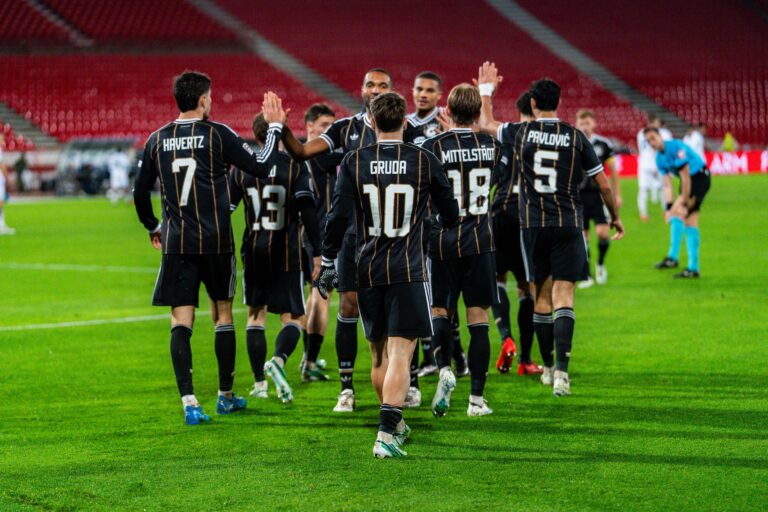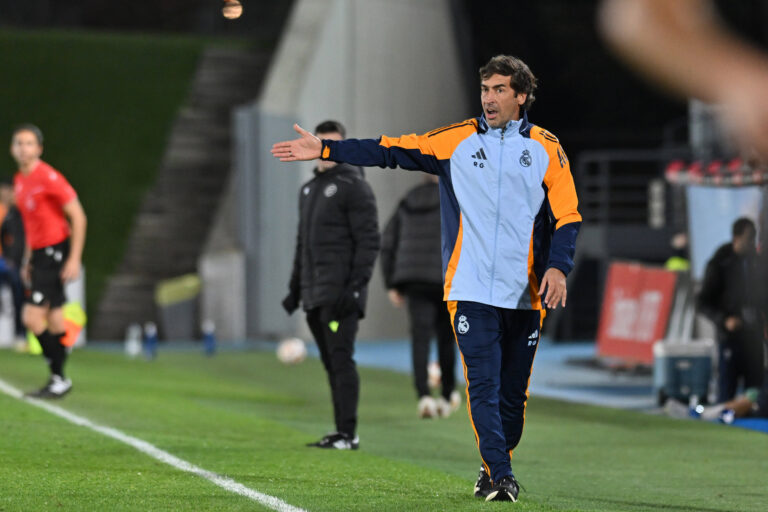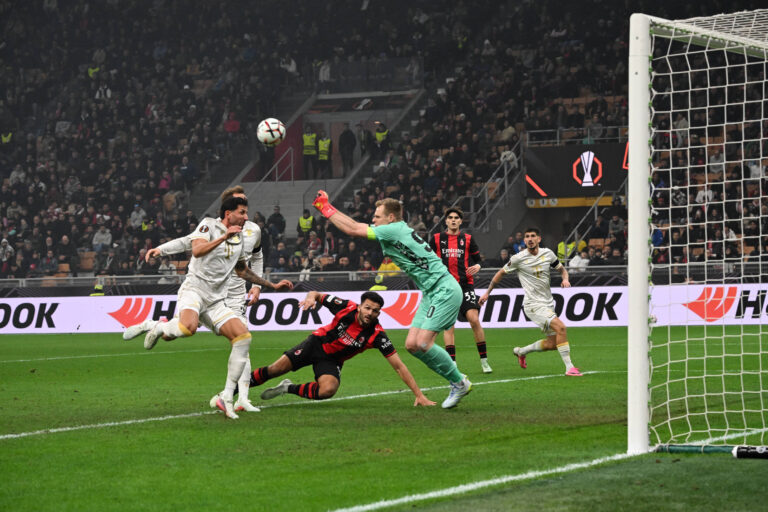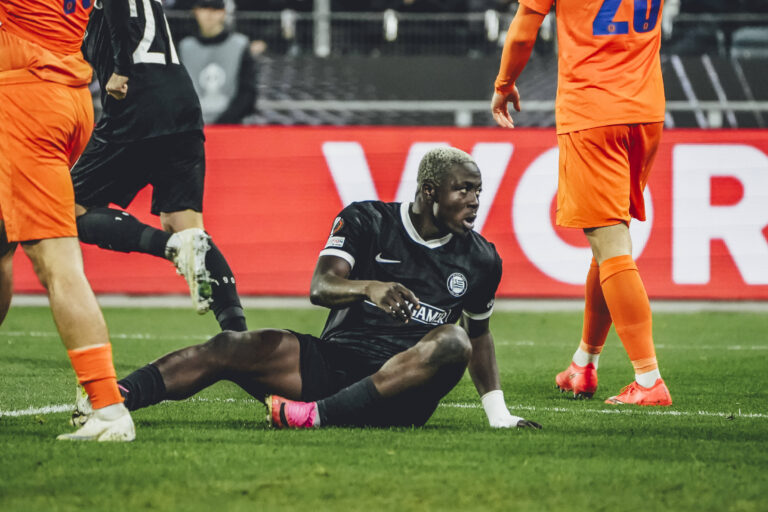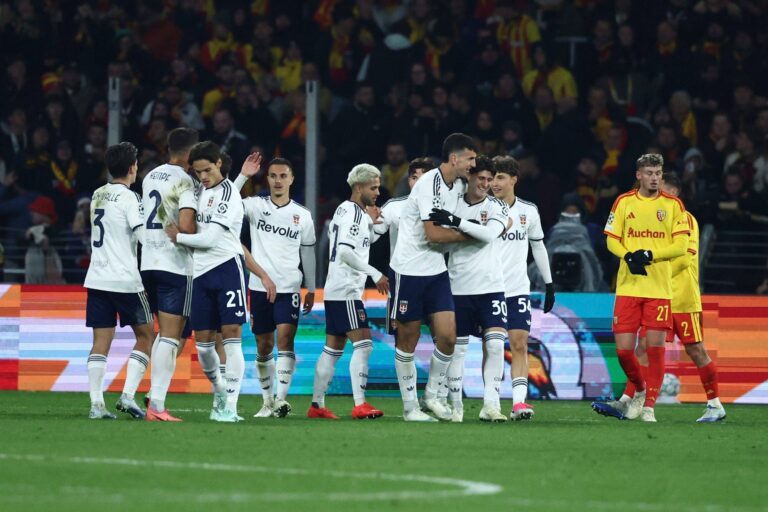
For 40 minutes at the Generali Arena, the Vienna derby followed an unfamiliar script. Instead of the runaway league leaders from Hütteldorf dictating proceedings, it was an Austria side that had struggled badly in recent weeks who took control. The Violets pushed Rapid deep into their own half, won second balls and unsettled the visitors with aggressive pressing. Yet the teams went into half-time goalless. Rapid gradually regained their footing after the break and secured a 2-0 victory through a Yusuf Demir penalty (60′) and a Tae-seok Lee own goal (82′).
Austria push Rapid to their limits
After a relatively even opening quarter of an hour, interim coach Maximilian Uhlig’s side increasingly took the initiative. Austria pressed Rapid’s build-up boldly, occupied the spaces between the lines effectively and prevented the visitors from establishing their customary passing combinations.
What stood out was just how little Rapid’s usually excellent positional play managed to produce. Matthias Seidl and Nicolas Bajlicz found virtually no time or space to orchestrate attacks through midfield. Yusuf Demir and Tonni Adamsen were rarely able to exploit their strengths between the opposition lines. Austria repeatedly forced the favourites into misplaced passes and hopeful long balls.
Between the 15th and 55th minutes, Rapid endured their worst spell of the campaign so far. Even during their 5-1 defeat to Salzburg, Johannes Hoff Thorup’s team had not been so comprehensively outplayed for such an extended period.
Vasilije Marković was one of the driving forces behind Austria’s impressive display. The young midfielder consistently made himself available between the lines, carried the ball forward and repeatedly troubled Rapid’s defence with his movement.
Marković struck the crossbar in the 27th minute. Shortly before half-time, Sanel Šaljić threatened after a pass from Johannes Eggestein, only for Nenad Cvetković to intervene with a crucial defensive clearance. Aleksandar Dragović also rose to meet a corner but headed over the bar.
Austria would have deserved to lead at the interval. Their inability to capitalise on that superiority would ultimately prove costly.
Cvetković keeps Rapid in the contest
It was Rapid’s two centre-backs who proved to be the visitors’ most important players during their difficult spell. Serge-Philippe Raux-Yao delivered a composed performance, but Nenad Cvetković was the outstanding figure.
The Serbian defender won a succession of decisive duels, anticipated opposition passes and repeatedly stepped out at precisely the right moment to neutralise dangerous situations. His ability to make sound decisions under sustained pressure prevented Austria’s territorial dominance from producing even more clear-cut chances.
Cvetković was not simply responsible for marking his direct opponent. He also had to cover spaces that opened up as a consequence of Rapid’s problems in midfield.
Austria enjoyed far more of the play, but whenever they advanced into the penalty area, they generally encountered a well-organised final line of defence.
At the same time, a familiar weakness in Austria’s attacking game became apparent: a lack of runs in behind. Eggestein frequently dropped towards the ball, while the attacking midfielders also tended to move into positions where they could receive possession to feet. Runs beyond Rapid’s defensive line were much less frequent.
As a result, even after successful recoveries, Austria often lacked a player capable of stretching the defence with a direct run into space.
Dragović’s mistake turns the match
The contest began to change around the 55-minute mark. Rapid improved their ability to compete for second balls and gradually started building attacks closer to Austria’s penalty area.
The breakthrough, however, did not result from sustained attacking pressure. Instead, it came from a defensive mistake. Dragović fouled Ercan Kara inside the box, prompting referee Stefan Ebner to award a penalty. Yusuf Demir calmly converted in the 60th minute to put Rapid ahead.
The incident highlighted a problem that has become increasingly noticeable as Dragović has grown older. The former Austria international captain still possesses considerable experience and excellent positional awareness. But when required to react quickly in open situations or defend larger spaces, he increasingly lacks the athleticism and acceleration of his younger years.
His foul on Kara was particularly frustrating for Austria because Rapid had by no means been the better team up to that point.
Once ahead, the visitors began to find considerably more room to operate and were able to make much greater use of their attacking quality.
Rapid suddenly create the better chances
In the 66th minute, Petter Nosa Dahl squandered an excellent opportunity from close range. Three minutes later, the Norwegian was denied again by Samuel Şahin-Radlinger, who also kept out Bendegúz Bolla’s follow-up effort.
Substitute Claudy Mbuyi should also have scored. The striker found himself in a promising position in the 81st minute but failed to beat the Austria goalkeeper.
This period illustrated why Rapid lead the Bundesliga: they do not necessarily need to dominate throughout a match to create several high-quality scoring opportunities. The decisive second goal arrived in the 82nd minute when Tae-seok Lee unfortunately turned the ball into his own net.
The statistics tell a tale of two halves
Over the full 90 minutes, Austria enjoyed 58 per cent possession and registered more shots, leading that category 16-11. The Violets also recorded 37 touches inside the opposition penalty area, compared with Rapid’s 23.
The expected goals figures, however, told a very different story. Rapid finished with 2.47 xG, while Austria managed just 1.07. Even accounting for the penalty, the visitors created the more valuable scoring opportunities overall.
Austria controlled the contest for a considerable period but too rarely turned their attacks into genuinely dangerous shooting positions. Rapid struggled for long stretches yet generated significantly greater goal threat with far fewer attacks after half-time.
Important lessons for both sides
For Uhlig, the defeat nevertheless offered initial evidence that his players are capable of producing more intense and ambitious football. Austria performed at a level for an extended period that few would have expected given their recent results. However, that does not disguise their continued lack of attacking penetration and individual quality in decisive situations.
Rapid, meanwhile, celebrated their tenth victory in eleven league matches and finally brought their winless derby sequence from last season to an end. Thorup is unlikely to have been pleased with the 40-minute spell during which his team had virtually no control of the contest.
Yet the fact that Rapid could emerge with a 2-0 victory despite enduring their worst period of the season within a single match also highlights an important new quality. Their central defenders kept them in the game, and their attacking players exploited the spaces that emerged later on.
Rapid return to action on Friday against Wolfsberger AC, while Austria travel to WSG Tirol the following Sunday. The league leaders will be looking to protect their position at the top; Uhlig, meanwhile, must ensure that a promising but ultimately unrewarded derby performance is followed by something his team desperately needs: points.