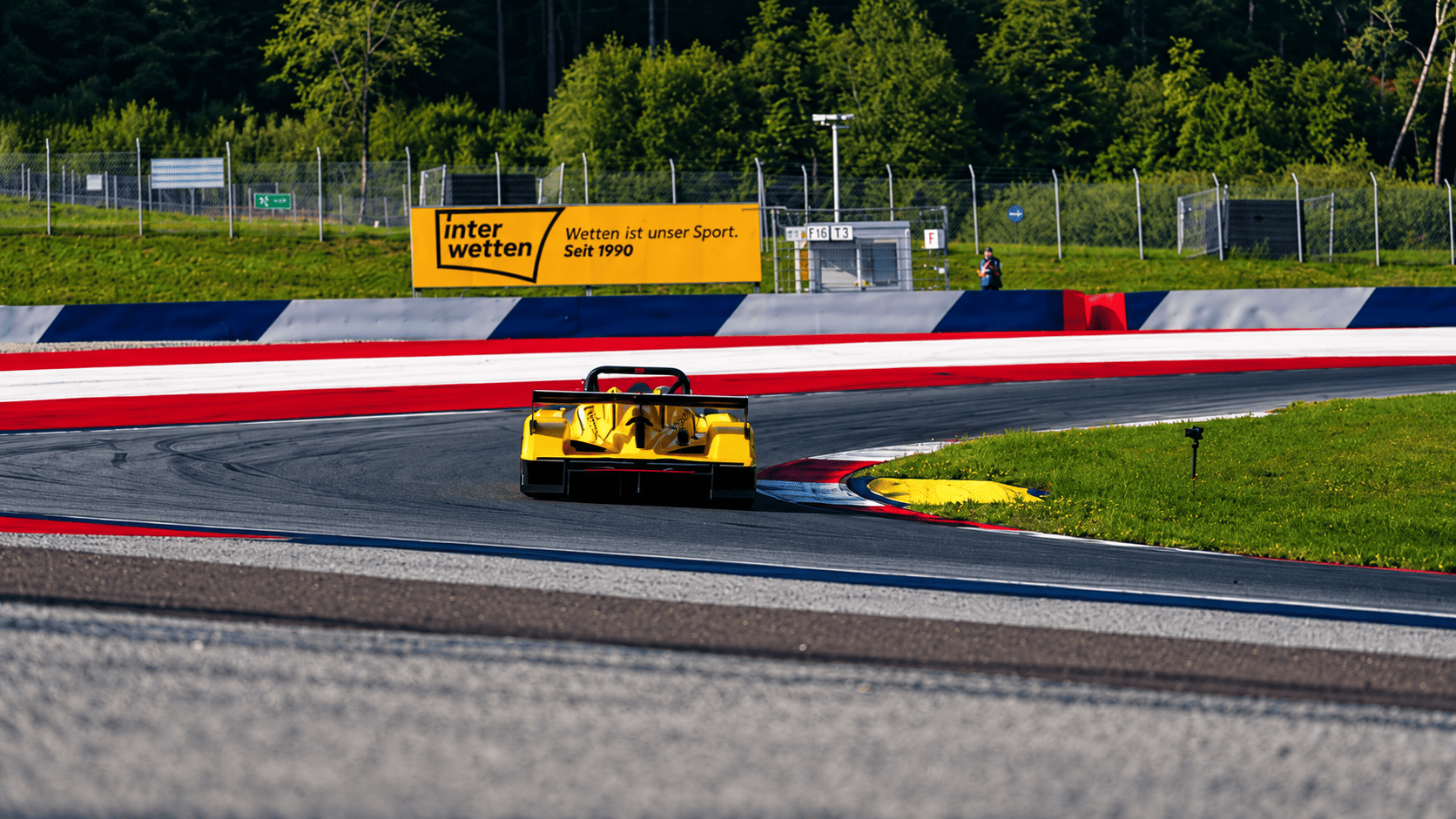
For the shoot, Klien swapped the expert’s role for the cockpit. Driving a sports prototype from Austrian manufacturer Pedrazza Racing Cars, he demonstrates the forces involved under braking, how the steep gradient affects a driver’s perception and why choosing the right line through Turn 3 is so important.
From more than 330 km/h down to around 70 km/h
The challenge begins well before the actual corner entry. From Turn 1 to the Interwetten Turn, drivers cover almost one kilometre at full throttle – with the track climbing steeply at up to twelve per cent towards the end of the run.
From the low seating position inside a racing car, the section feels even more extreme, according to Klien. “When it suddenly goes up at twelve per cent, it feels as though you’re driving into a wall.”
Klien says Formula 1 cars arrive at Turn 3 at more than 330 km/h before slowing to around 70 km/h. The key is not simply to brake as late as possible. The driver also has to hit the apex cleanly and keep the car stable for the acceleration phase on corner exit.
You are currently viewing a placeholder content from YouTube. To access the actual content, click the button below. Please note that doing so will share data with third-party providers.
More InformationThe crest makes the exit especially demanding
Turn 3 is a tight right-hander of slightly more than 90 degrees. The topography adds another layer of difficulty: the track rises over a crest on corner exit, making the rear of the car feel lighter.
Klien explains in the video that traction therefore becomes crucial. A driver who gets back on the throttle too aggressively or fails to position the car cleanly risks the rear stepping out. At the same time, carrying speed out of the corner is vital because another long acceleration zone follows immediately towards Turn 4.
That also makes the section particularly important in wheel-to-wheel racing. Turn 3 is one of the Red Bull Ring’s key overtaking zones – and according to Klien, defending successfully here is largely about choosing the right line. Anyone braking late on the inside must still make sure they get a clean exit.
Just ten corners, but major elevation changes
With only ten corners, the Red Bull Ring can look relatively straightforward on paper. In reality, the considerable elevation changes make the circuit far more demanding than the layout alone might suggest.
The original circuit in Spielberg was opened in 1969. Formula 1 raced at the Österreichring from 1970 to 1987 and returned after the circuit was rebuilt as the A1-Ring from 1997 to 2003. The championship came back to the modern Red Bull Ring in 2014 and has been a regular fixture in Spielberg ever since.
Turn 3 plays a particularly important role on the relatively short circuit. Very high approach speeds, heavy braking, a steep gradient, precise line choice and a difficult exit all come together within the space of just a few seconds.
Interwetten expands its motorsport involvement
The former Formula 1 driver has been working as an Interwetten expert since this season and is pleased that Turn 3 is now officially known as the Interwetten Turn: “It underlines the brand’s strong connection with motorsport in the perfect way.”
For Interwetten, the naming partnership represents another step in its long-standing relationship with racing. “Motorsport has always been a central pillar throughout our more than 35-year company history,” the company said. With the Interwetten Turn, it is aiming to create “a highly visible statement at one of the most popular race tracks in the world.”


