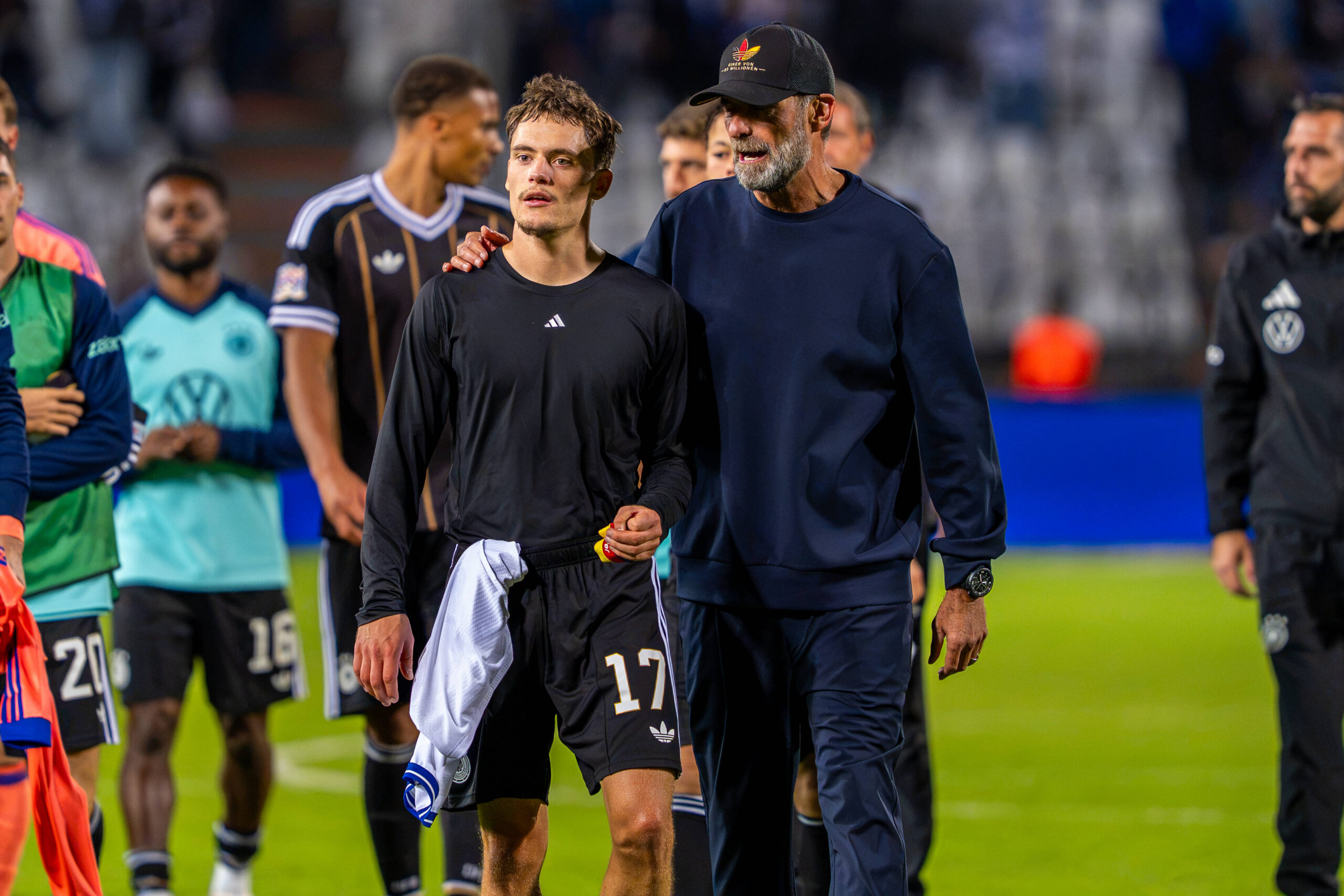
Greece have therefore continued their surprisingly strong start to the competition. The group outsiders remain unbeaten after four matches and sit on eight points, still ahead of Germany, who have collected only five. The visitors dominated large spells, particularly before half-time, but failed to turn that control into enough clear-cut chances.
Klopp makes only three changes
Klopp made three changes from the 2-0 win over Serbia. David Raum, Lennart Karl and Jonathan Burkardt came into the side for Maximilian Mittelstädt, Serge Gnabry and Nick Woltemade. Jonas Urbig remained in goal, Aleksandar Pavlović operated as the holding midfielder behind Tom Bischof and Florian Wirtz, while Derry Scherhant and Karl occupied the flanks.
Greece were without Christos Tzolis, while Konstantinos Karetsas started on the bench. Ivan Jovanović opted for a compact 4-2-2-2 that dropped very deep without the ball. Kourbelis and Zafeiris protected the centre, while Pavlidis and Ioannidis were expected to provide an outlet after turnovers.
Germany’s approach was based on sustained possession, high full-backs and quick counter-pressing. Greece were happy to concede the ball and instead focused on closing the spaces in front of their penalty area.
Urbig prevents an early setback
Greece almost took the lead after only two minutes. Tsimikas advanced down the left and crossed for Masouras, who was left free to head at goal from close range. Urbig reacted sharply and kept Germany level.
From that point on, the visitors took control. Wirtz repeatedly found pockets between the lines, Bischof pushed into the attacking half-spaces and Scherhant caused the greatest problems on the left with his direct dribbling. Greece were forced deep into their own half and struggled to create any sustained relief.
Burkardt goal ruled out after VAR intervention
After just over half an hour, Germany appeared to have found the breakthrough. Bischof won possession in midfield and released Scherhant on the left. The winger drove towards the byline and cut the ball back for Burkardt, who finished from close range.
The build-up was subsequently reviewed by VAR. Bischof had handled the ball before the move developed, prompting referee Clément Turpin to disallow the goal.
Germany continued to apply pressure. By half-time, they had registered 13 shots to Greece’s one and enjoyed 76 per cent possession, yet their xG total stood at only 0.59. Greece defended their penalty area with discipline and repeatedly forced the visitors into difficult attempts.
Greece find greater stability after the break
The match became more balanced after half-time. With Karetsas on the pitch, Greece gained more presence between the lines and found it easier to play through Germany’s first pressing wave. Mavropanos also became a threat from set pieces.
The centre-back was equally important at the other end and produced the strongest individual defensive display of the match. In 78 minutes, he made 12 clearances, blocked a shot and won three of his four aerial duels. Tzolakis behind him made four saves and claimed four high balls.
Germany still saw much more of the ball, but lost some of the clarity they had shown before the break. Pavlović was one of the visitors’ strongest performers thanks to his composure, positioning and work as the lone holding midfielder. Wirtz continued to search for solutions between the lines, while Karl had considerably less influence on the right than Scherhant did on the opposite flank.
Klopp introduced El Mala and Woltemade shortly after the hour mark. The game initially became more disjointed, however, while Greece began defending slightly higher and spent more time in Germany’s half.
Plenty of control, but too little cutting edge
Germany increased the pressure again late on. Treu had one promising opportunity and El Mala also got a shot away, but the decisive goal never came.
The final numbers help explain the 0-0. Germany led 21-5 in shots and 45-8 in touches inside the opposition penalty area, yet the xG count was only 1.05 to 0.72. Greece even registered two big chances compared with Germany’s one.
Germany therefore did not lack activity, but rather quality in the decisive moments. Against Greece’s compact block, the visitors too rarely found the final pass into central finishing positions. The hosts defended precisely those areas extremely well.
Greece underline their impressive start
For Greece, the draw is further confirmation of an excellent start to the Nations League. After beating Serbia 2-1, winning 1-0 in Germany and drawing 2-2 with the Netherlands, Jovanović’s side remain unbeaten. With eight points, they sit three ahead of Germany.
Germany’s record under Klopp — one win, two draws and one defeat — has been far less convincing. The frequent personnel changes clearly play a part, particularly with several players either making their first appearances together or having only limited experience alongside one another. At the same time, Germany still possess enough individual quality, even in a heavily rotated line-up, to create more danger against opponents such as Greece.
What remains noticeable is that the patterns in Klopp’s relatively new system are not yet functioning consistently. The high press and quick recoveries already work well in phases, but Germany still lack coordinated movement and established automatisms in possession against deep defensive blocks. As a result, their attacking play often became predictable despite their territorial dominance.
Germany travel to Serbia in November before hosting the Netherlands. Those matches should provide a clearer indication of whether Klopp can take the next step offensively with a more settled and potentially stronger line-up.