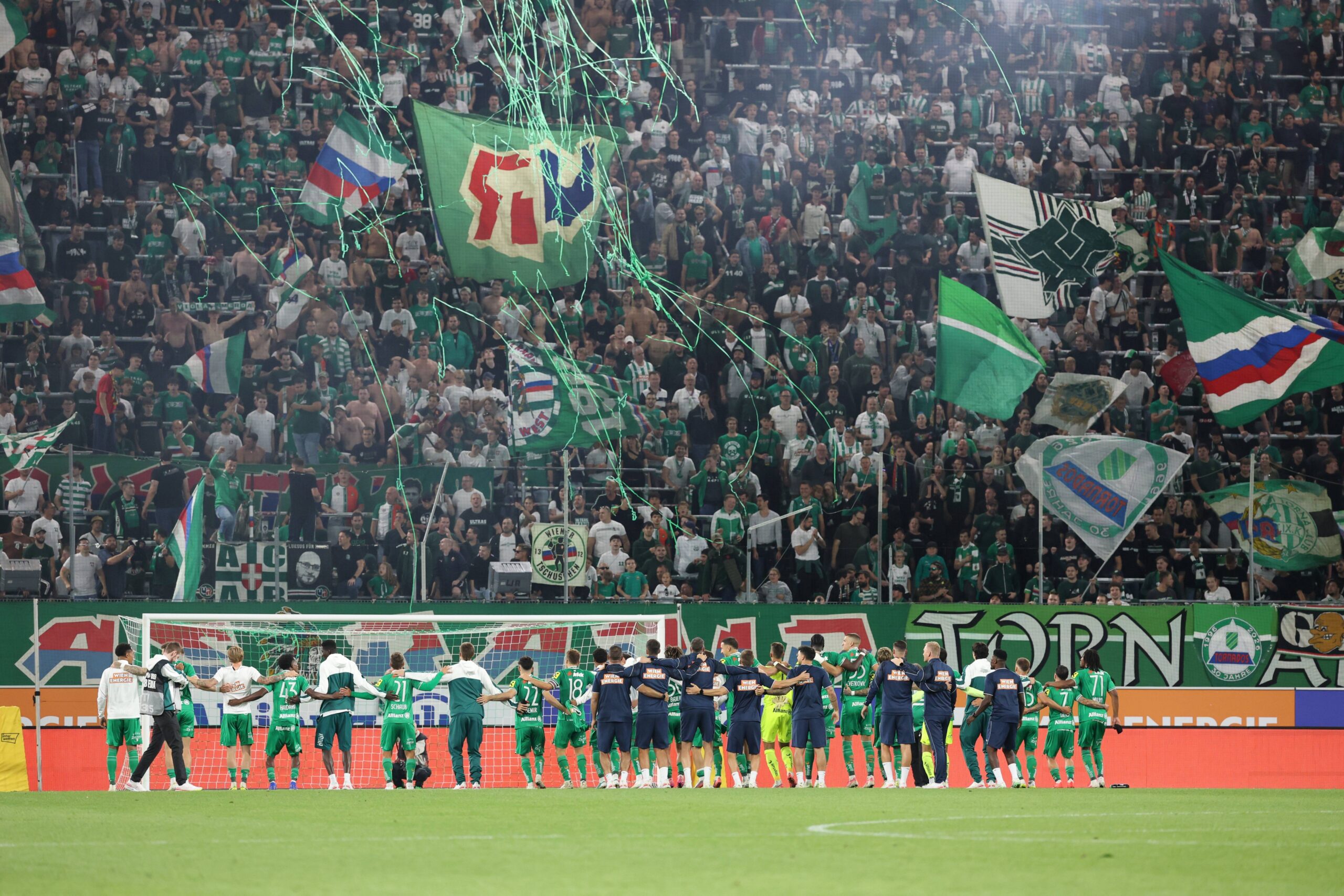
With six victories from seven Bundesliga matches, Rapid have made their best start to a season since 1998. Johannes Hoff Thorup’s side now have 18 points and move to the top of the table, at least until the remaining fixtures of matchday seven have been played.
Thorup brings Kara and Horn into the starting XI
Thorup made two changes from the 3-0 away win over WAC. Jannes Horn replaced Eaden Roka at left-back, while Ercan Kara came in for Moulaye Haïdara. Tonni Adamsen dropped into the role behind the centre-forward. Yusuf Demir and Petter Nosa Dahl occupied the wide positions, with Matthias Seidl and Nicolas Bajlicz in central midfield.
WSG coach Philipp Semlic made just one alteration following the 2-2 draw with Hartberg, bringing Moritz Wels in for Husein Balić. Without the ball, the visitors frequently dropped into a 4-4-2 and tried to force Rapid’s build-up towards the flanks.
The approach worked reasonably well early on. WSG found several good pressing moments and repeatedly managed to combine their way out of their own half after regaining possession. They lacked pace and precision in the final third, however. Wels had an early attempt, but Niklas Hedl was barely tested again before half-time.
Kara rewards Rapid’s growing pressure
Rapid saw more of the ball but initially struggled to find dangerous spaces against Tirol’s compact shape. The final pass and deliveries into the box were too often inaccurate.
Demir was already one of Rapid’s most influential players during this phase. He regularly looked for one-on-one situations and drifted inside from the right into the half-space, drawing defenders towards him and opening room for Bolla to advance.
Rapid thought they had taken the lead after 24 minutes when Kara headed a cross into the net, but the striker had been marginally offside as the delivery came in and the goal was ruled out.
Nine minutes later, the opener did count. Horn was given enough space on the left to deliver an accurate cross and picked out Kara inside the box. The striker created separation from his marker and headed Rapid into a 1-0 lead.
The advantage was deserved, although WSG continued to keep the match competitive throughout the opening half. Semlic’s side disrupted Rapid’s rhythm and forced the hosts into longer passes more often than Thorup would have liked.
Demir drives Rapid’s dominant second half
The complexion of the game changed noticeably after the interval. Rapid increased the tempo, played through central areas with greater accuracy and found free players between the Tirol lines far more regularly.
Thorup later explained that his team had lacked sharpness and concentration before the break. The coaching staff showed the players several situations at half-time, and the response was immediately apparent.
Demir in particular began to dictate the game. Shortly after the restart, he struck the angle of post and bar following an individual move. His close control and rapid changes of direction made him extremely difficult for WSG to contain, and his six successful dribbles were comfortably the highest figure of the match.
His tendency to move inside also opened the right flank for Bolla. Horn pushed forward more consistently on the opposite side, allowing Rapid to stretch the Tirol defence without losing their connections through the middle.
The numbers reflected Rapid’s increasing control. The hosts finished with 17 attempts and 32 touches inside the opposition penalty area, while WSG managed only five shots and 13 touches in Rapid’s box.
VAR controversy adds to the intensity
The most contentious incident of the match came during Rapid’s strongest spell. After Bolla was initially denied by Hamzić following a delivery from the left, the ball eventually reached Dahl via Demir. The Norwegian’s close-range effort struck the arm of a Tirol defender.
Referee Harald Lechner was sent to the monitor by the VAR but, after reviewing the footage, stuck with his original decision and did not award a penalty. For the first time in the Austrian Bundesliga, footage from an on-field review was shown on the stadium screens, before Lechner explained his decision over the public-address system.
Rapid’s players and supporters reacted strongly. The lengthy interruption did not disrupt the hosts, though. If anything, the atmosphere added further intensity to an already dominant spell as Rapid immediately continued to push for a second goal.
Bolla caps Rapid’s strongest spell
Just a few minutes later, Rapid combined cleanly through the Tirol defence. Adamsen laid the ball off inside the area, Bolla arrived from his advanced position and fired emphatically under the crossbar for 2-0.
The goal summed up Rapid’s second half. Their movement became clearer, passes into depth were more precise and decisions around the penalty area were made more quickly. Their counter-pressing also improved. Seidl and Bajlicz pushed up more aggressively after turnovers, while the back line stepped forward quickly whenever WSG attempted to clear long.
The xG figures underline that the convincing scoreline was not simply a product of clinical finishing. Rapid generated 2.85 xG compared with just 0.36 for WSG. Most notably after half-time, the hosts created a series of higher-quality opportunities while Tirol struggled to reach Rapid’s penalty area in a controlled manner.
Semlic pointed to his side’s intensity in the press after the game but also acknowledged that Rapid held physical advantages in several decisive situations.
Wurmbrand finishes off the counterattack
As the game wore on, additional spaces opened up for Rapid. WSG had to defend higher and commit more players forward, allowing the hosts to become increasingly dangerous in transition.
The third goal came from exactly that type of situation. Nenad Cvetković won the ball with an aggressive sliding challenge on the edge of his own penalty area. Bajlicz immediately recognised the opportunity and played an accurate through ball down the middle for Wurmbrand.
The substitute used his pace to get away from the Tirol defence and calmly finished in the 86th minute to make it 3-0.
Rapid temporarily move top of the table
Rapid therefore head into the three-week international break with six wins from seven matches and their best start to a Bundesliga season in 28 years. Their home record has been particularly impressive: the Green-Whites have scored 15 goals and conceded just once in four league matches at the Allianz Stadion.
The victory takes Rapid to 18 points and, for the time being, top spot in the Bundesliga. Whether they remain there will depend on the remaining fixtures from matchday seven.
Rapid return to league action on October 11, when they travel to the Raiffeisen Arena for a top-of-the-table clash with LASK.