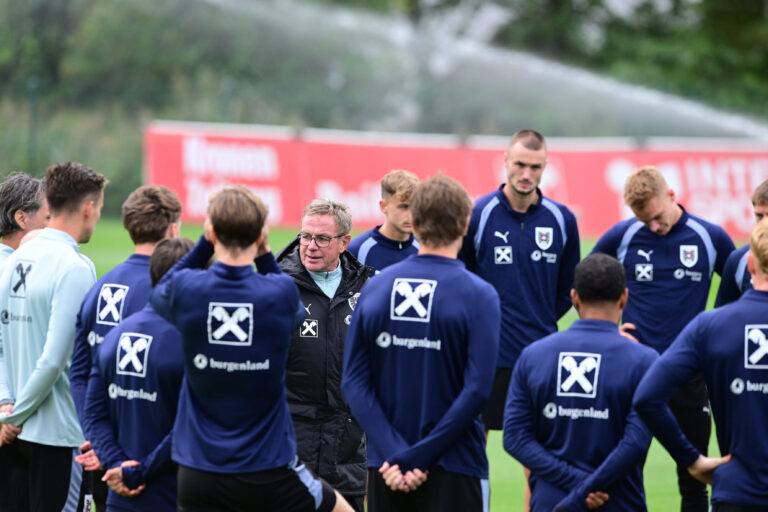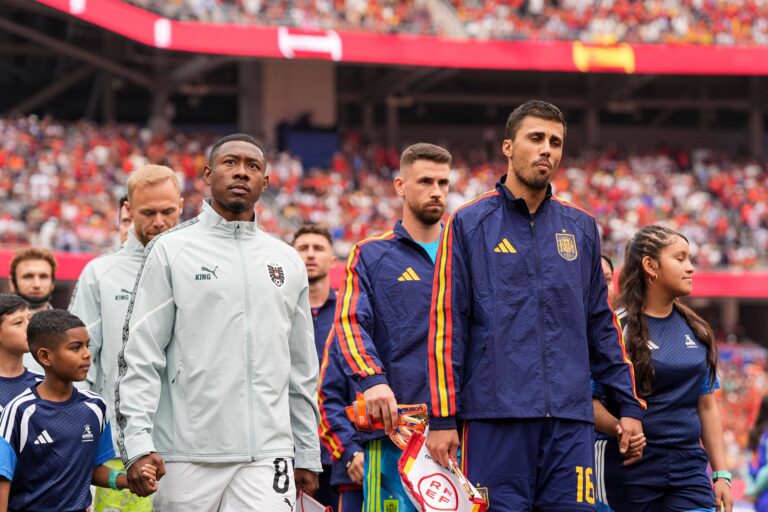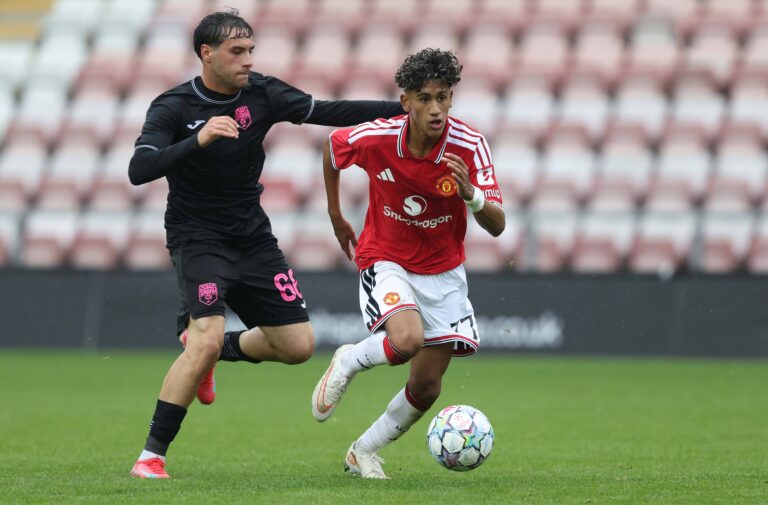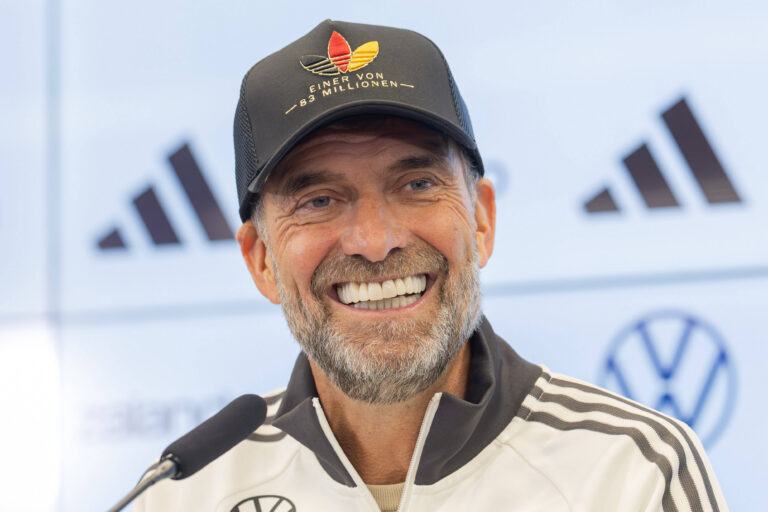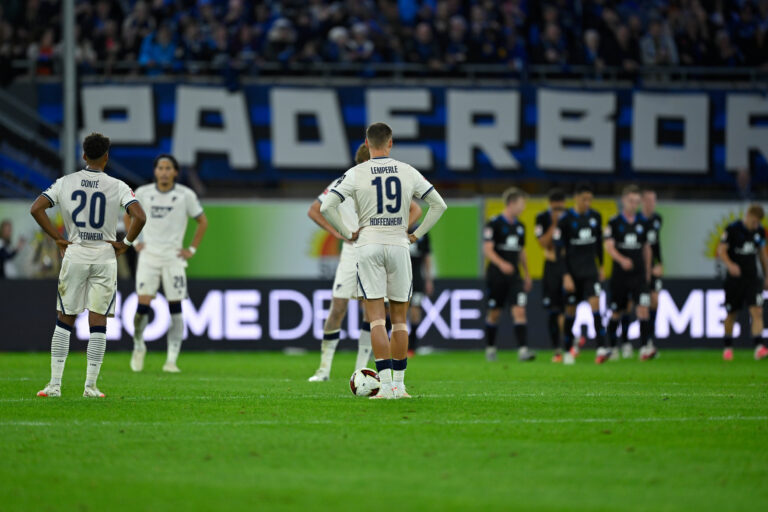
Following Austria’s round-of-32 exit against Spain at the World Cup, a new phase in the national team’s development is now clearly beginning. Austria will compete in League B of the Nations League and face four matches within the space of just eleven days in their opening international window. Rangnick has therefore named a relatively large 27-man squad.
Alaba, Sabitzer and Arnautovic all absent
The three most prominent absentees are players who have shaped the national team for many years. Marko Arnautovic retired from international football after the World Cup, bringing his Austria career to an end with 137 caps and 49 goals. Marcel Sabitzer, meanwhile, has temporarily stepped away from international duty after 102 appearances. The 32-year-old wants to manage his workload given the demands at Borussia Dortmund, although a return ahead of the Euro 2028 qualifiers remains possible.
Captain David Alaba is also missing. The 34-year-old remains without a club after the expiry of his Real Madrid contract and has not played a competitive match since Austria’s World Cup exit in early July. Given his lack of match practice, his omission from this squad comes as little surprise.
Christoph Baumgartner is still sidelined by the serious thigh injury he suffered shortly before the World Cup. At the beginning of September, the RB Leipzig midfielder was still training individually and expected to need several more weeks before making his return.
Compared with the World Cup squad, Florian Grillitsch and Michael Svoboda are also absent. Alessandro Schöpf has only been named on standby. There is also a notable change in goal, with Patrick Pentz – still part of the three-man goalkeeper group at the World Cup – included only on the reserve list.
Two new goalkeepers get their chance
Instead, two young Austrian Bundesliga goalkeepers have earned their first senior call-ups. Lukas Jungwirth is no longer merely a prospect at LASK, having established himself as the undisputed first-choice goalkeeper last season. The 22-year-old played all 32 Bundesliga matches in 2025/26 and has started the new campaign strongly as well, keeping three clean sheets in his first five league appearances. His composure in possession and ability with the ball at his feet fit well with Rangnick’s demands on a modern goalkeeper.
Christian Zawieschitzky is at an earlier stage of his development. The 19-year-old was promoted to first choice at Red Bull Salzburg following Alexander Schlager’s move to Werder Bremen. Despite his limited experience, the Tyrolean has already impressed at a higher level and has established himself as Salzburg’s regular starter this season. His inclusion is primarily an investment in the future.
Bacher and Veratschnig rewarded for strong club starts
There are also two potential debutants in defence. Felix Bacher made another step forward in his career by joining Olympique Lyon in the summer. After two years as a regular starter at Estoril, the 25-year-old centre-back immediately earned a place in Lyon’s first XI and has already scored in Ligue 1. Standing 1.90 metres tall and bringing physicality as well as experience from three European leagues, he gives Rangnick another option in central defence.
Nikolas Veratschnig moved to Red Bull Salzburg this summer after two years at Mainz 05 – and is now getting the regular playing time that was sometimes missing in Germany. The quick right-back has contributed one goal and one assist in his first five Bundesliga matches. His pace, attacking instincts and ability to cover the entire right flank make him an interesting fit for Rangnick’s high-intensity approach.
Rangnick rewards Lang’s strong start to the season
Christoph Lang has previously been part of the wider national-team picture but is still waiting for his senior debut. The LASK attacker has earned another opportunity with an excellent start to the campaign, scoring four goals in his first five Bundesliga appearances and emerging as one of the standout players for the league leaders.
Lang can operate in several attacking roles and brings the directness Rangnick values in wide areas. With Arnautovic retired and Baumgartner unavailable, new roles are opening up in Austria’s attacking structure, giving several players the chance to establish themselves.
Markovic call-up carries additional significance
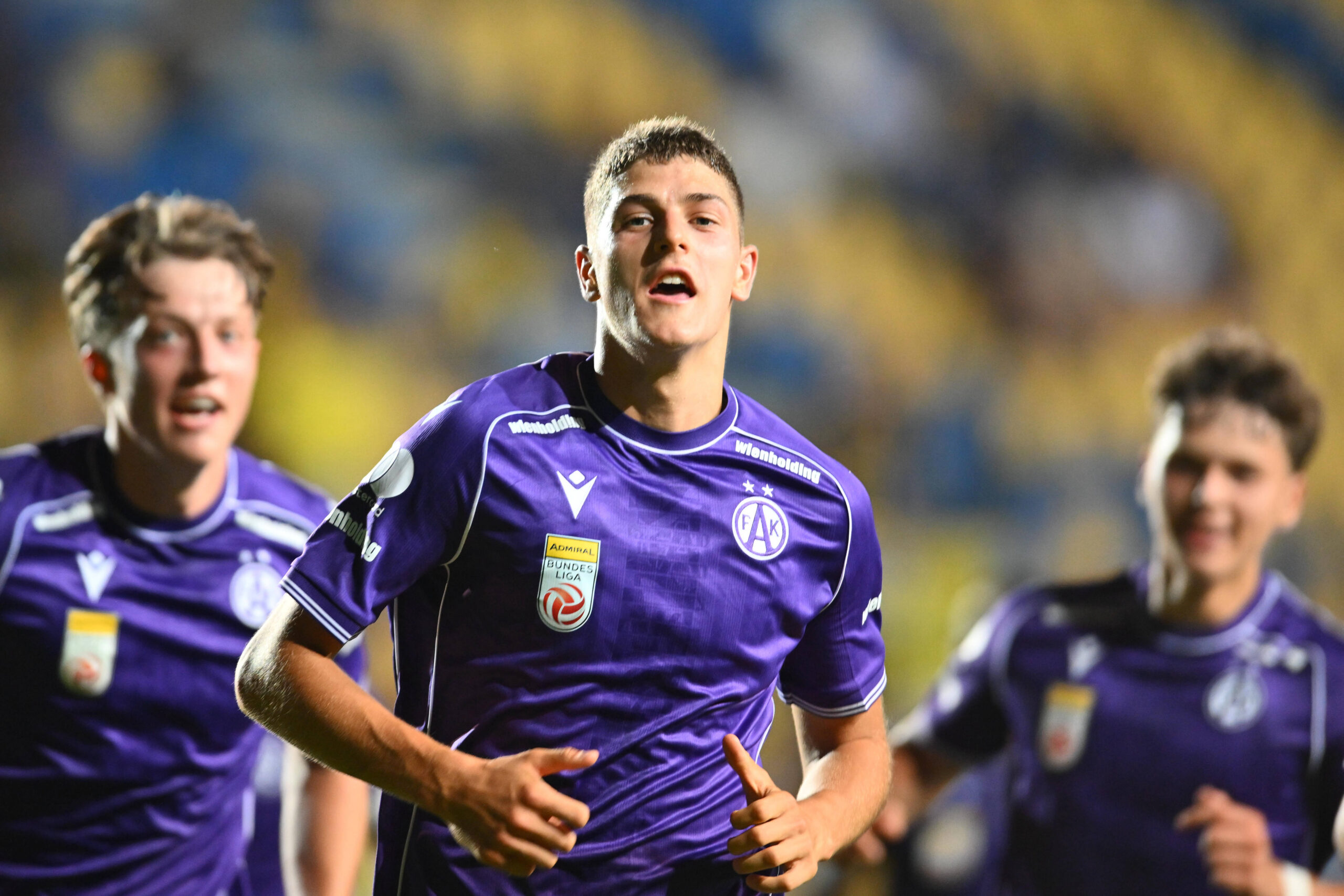
The most intriguing selection, however, is Vasilije Markovic. The 18-year-old midfielder has developed from an academy prospect into a Bundesliga regular at Austria Wien within a matter of months. He was already one of Austria’s standout talents at the 2025 U17 World Cup, where the team sensationally finished runners-up. Austria Wien extended his contract until 2029 only a few days ago.
His call-up also carries significance beyond the purely sporting aspect. Markovic has Serbian roots and the Serbian football association has recently attempted to convince him to switch international allegiance. Serbian media even reported on an “Operation Vasilije”. Markovic himself subsequently made it clear that he has represented Austria since U15 level and that playing for the senior national team has always been his ambition.
This selection brings that goal significantly closer. From a sporting perspective, he is likely to be introduced initially as an alternative in central midfield behind Xaver Schlager, Nicolas Seiwald and Konrad Laimer. With four matches in a short period, however, Rangnick should have ample opportunity to give the 18-year-old his first senior minutes.
Four matches in eleven days
Austria begin their Nations League campaign against Israel in Linz on 24 September at 20:45. Three days later, Kosovo visit the Ernst-Happel-Stadion in Vienna for an 18:00 kick-off. Austria then travel to Dublin to face the Republic of Ireland on 1 October at 20:45, before meeting Kosovo again in Pristina on 4 October at 18:00. The final two group matches against Ireland and Israel will take place in November.
Austria squad for the UEFA Nations League
Goalkeepers
Lukas Jungwirth (LASK; 0)
Alexander Schlager (SV Werder Bremen/GER; 30)
Florian Wiegele (Viktoria Plzeň/CZE; 1)
Christian Zawieschitzky (FC Red Bull Salzburg; 0)
Defenders
David Affengruber (Fulham FC/ENG; 1/0)
Felix Bacher (Olympique Lyon/FRA; 0)
Kevin Danso (Sunderland AFC/ENG; 36/0)
Marco Friedl (SV Werder Bremen/GER; 12/0)
Philipp Lienhart (SC Freiburg/GER; 43/3)
Phillipp Mwene (1. FSV Mainz 05/GER; 32/0)
Stefan Posch (1. FSV Mainz 05/GER; 56/5)
Alexander Prass (TSG 1899 Hoffenheim/GER; 21/0)
Nikolas Veratschnig (FC Red Bull Salzburg; 0)
Maximilian Wöber (FC Schalke 04/GER; 31/0)
Midfielders
Carney Chukwuemeka (Borussia Dortmund/GER; 6/1)
Christoph Lang (LASK; 0)
Konrad Laimer (FC Bayern München/GER; 61/7)
Vasilije Markovic (FK Austria Wien; 0)
Romano Schmid (Frosinone Calcio/ITA; 38/4)
Xaver Schlager (Nottingham Forest FC/ENG; 55/4)
Nicolas Seiwald (RB Leipzig/GER; 51/1)
Paul Wanner (PSV Eindhoven/NED; 7/0)
Patrick Wimmer (TSG 1899 Hoffenheim/GER; 32/1)
Forwards
Junior Adamu (FC Schalke 04/GER; 9/0)
Michael Gregoritsch (FC Augsburg/GER; 78/24)
Marco Grüll (SV Werder Bremen/GER; 8/0)
Sasa Kalajdzic (LASK; 25/5)
On standby
Oluwaseun Adewumi (Hertha BSC/GER; 0)
Thierno Ballo (AS Saint-Étienne/FRA; 1/0)
Yusuf Demir (SK Rapid; 4/0)
Raul Florucz (Royale Union St. Gilloise/BEL; 3/0)
Jacob Peter Hödl (SK Puntigamer Sturm Graz; 0)
Sascha Horvath (LASK; 0)
Erik Kojzek (FK Partizan/SRB; 0)
Nicolas Kristof (SV Elversberg/GER; 0)
Patrick Pentz (Bröndby IF/DEN; 18/0)
Nikolas Polster (NEC Nijmegen/NED; 0)
Leopold Querfeld (1. FC Union Berlin/GER; 5/0)
Matthias Seidl (SK Rapid; 8/1)
Jannik Schuster (Brentford FC/ENG; 0)
Alessandro Schöpf (LASK; 35/6)
Nikolaus Wurmbrand (SK Rapid; 2/1)
Valentin Zabransky (FC Red Bull Salzburg; 0)