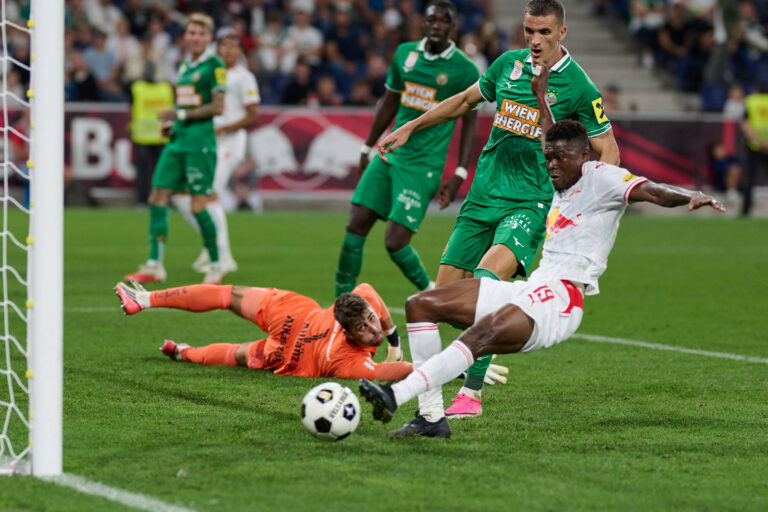
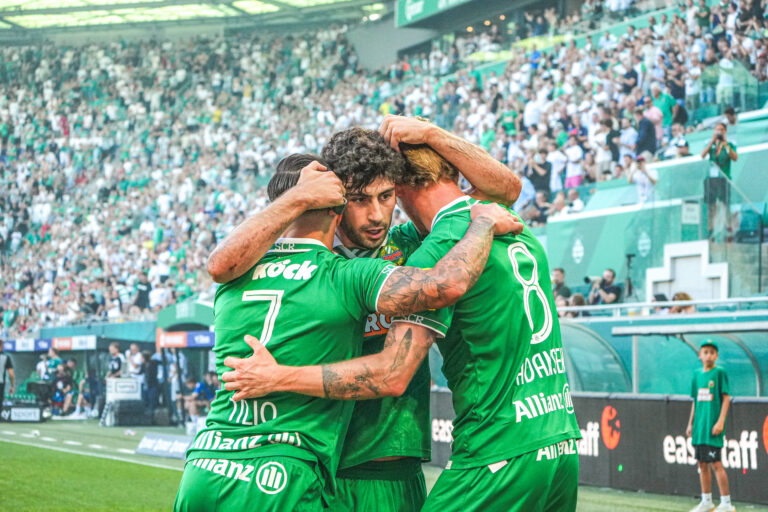
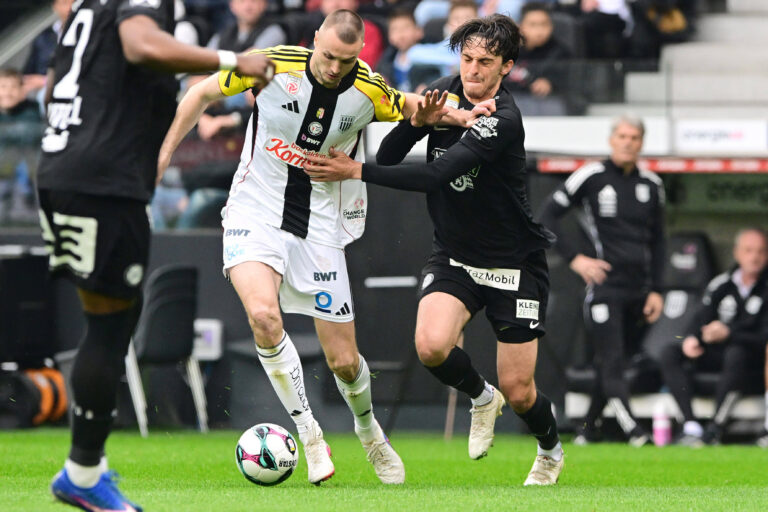
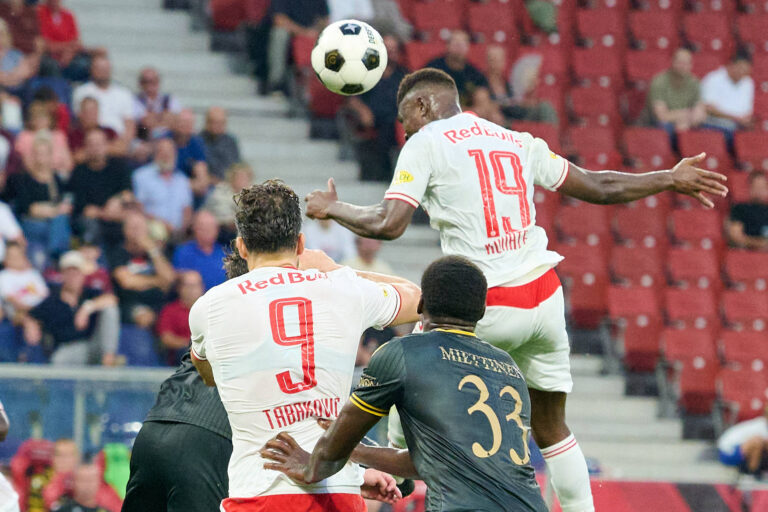
It did not take long for the direction of the evening to become clear. After Matthias Seidl hit the post, Ercan Kara reacted quickest to the rebound and made it 1-0 in the fifth minute. Seven minutes later, the centre-forward headed in a Jannes Horn cross for the second before Tonni Adamsen immediately added a third. GAK briefly threatened through Peter Michorl, but otherwise the hosts were almost completely in control. Nenad Cvetkovic headed home the fourth in the 42nd minute, before Adamsen made it 5-0 before half-time.
Anyone expecting Rapid to ease off after the break was quickly proven wrong. Yusuf Demir scored the sixth in the 56th minute before Adamsen added two more to complete a remarkable four-goal haul. The Dane was the standout performer of the evening, while Kara scored twice and Cvetkovic and Demir added one each. The 8-0 win was Rapid’s biggest victory since the Allianz Stadion opened and their biggest Bundesliga triumph since a 10-0 win over – once again – GAK in September 1985.
A statistical show of force
The scoreline was emphatic, but it was by no means the product of freakish finishing in an otherwise even contest. Quite the opposite: the numbers clearly reflected the balance of power.
Rapid had 72 per cent possession, registered 27 shots and recorded 43 touches inside the opposition penalty area. GAK managed nine attempts and only eight touches in Rapid’s box. The expected-goals figures were even more striking: Rapid created chances worth 5.49 xG, while the visitors finished on just 0.76.
This time, the possession figures were anything but sterile. Rapid moved the ball quickly, consistently found free players between and inside GAK’s defensive lines and switched play at the right moments. Their passing accuracy also made it extremely difficult for the visitors to gain any control. Rapid completed more than twice as many passes as GAK and found a team-mate with more than 90 per cent of them.
Most impressive of all was the fact that Rapid’s intensity barely dropped as the game went on. That was a stark contrast to the 2-0 win over Paide only a few days earlier, when the Viennese side had looked sluggish for long periods and head coach Johannes Hoff Thorup criticised the lack of tempo in the final third afterwards.
Rapid’s best performance under Thorup
Against GAK, Rapid produced by far their strongest response yet. They were superior technically, physically, tactically and in terms of intensity. The distances between the lines were right, counter-pressing after turnovers was immediate and, in possession, the team kept finding new solutions.
With eight goals, the temptation is naturally to single out individual attacking players. Adamsen’s four goals were exceptional, Kara was highly efficient with his brace and Seidl provided three assists. Yet the most striking feature of the performance was the collective strength of the team.
There was hardly a Rapid player who stood out simply because almost everyone fitted seamlessly into the overall structure. The centre-backs stepped forward aggressively, the full-backs were constantly involved in attacks, central midfield controlled both the tempo and counter-pressing, and the front line moved with great variety. Even after the substitutions, the structure remained intact.
Thorup summed it up accordingly after the game: “It was good football from us, with a lot of good moments and a lot of quality. But the most important thing is a team that sticks together in everything we do.” The Dane even admitted it may have been the first time in his coaching career that he had been able to sit back during a match and simply enjoy watching his team.
Feldhofer endures his “darkest moment”
At the other end of the spectrum, GAK were completely overwhelmed by Rapid’s tempo. The Graz side lost too many direct duels, defended their own penalty area alarmingly poorly and never managed to control the spaces out wide or between the lines.
Ferdinand Feldhofer was brutally honest afterwards: “It was terrible. We were overrun from the very beginning.” The former Rapid coach described the defeat as the worst sporting moment of his career as either a player or a coach and apologised to the GAK supporters.
Some of the travelling fans had already made their feelings clear during the match. A banner reading “Feldhofer raus!” – “Feldhofer out!” – was displayed in the away end during the second half, while several supporters left the stadium early. Feldhofer himself said he understood the anger and admitted that after an 8-0 defeat, the fans had every right to voice their frustration.
Rapid head to Edinburgh full of confidence
The emphatic win sends Rapid to the top of the table and leaves them with eight victories from eight competitive matches. The mood could hardly be better ahead of the first major test of the season: on Thursday, the Vienna side travel to Edinburgh for the first leg of their Conference League play-off against Heart of Midlothian. The return leg follows six days later in Vienna, before Rapid host SK Sturm Graz in the Bundesliga.
GAK, meanwhile, are back in action as early as Friday away to SV Ried – although whether Ferdinand Feldhofer will still be in charge by then is at least open to question. An 8-0 defeat, a performance in which the team were inferior in every department and public calls for the coach’s dismissal from their own supporters are difficult to simply brush aside. It would therefore be no surprise if the club’s hierarchy now held a fundamental discussion about Feldhofer’s future.