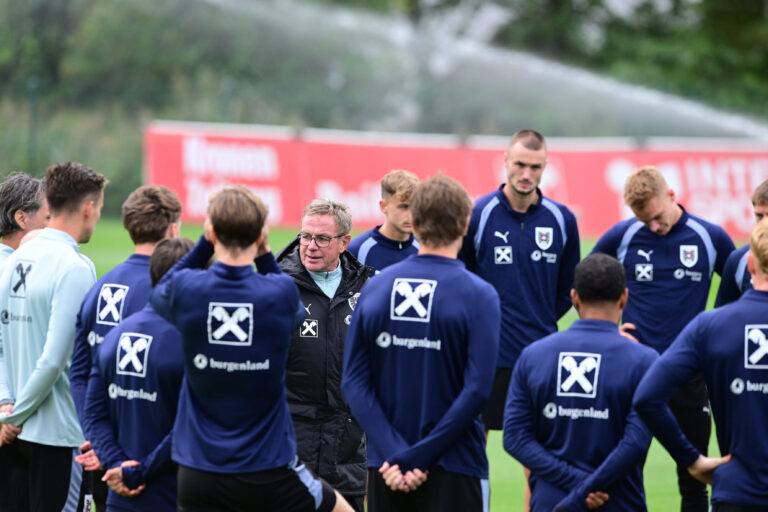
Over the full 90 minutes, Austria were deserved winners. They registered 19 attempts and an xG figure of 2.51, while Israel managed just five shots and produced only 0.21 xG. The match nevertheless showed that Rangnick’s side still lacked speed and precision at times when faced with a compact defensive block.
Rangnick forced to reshuffle his starting XI
Austria were without several prominent members of what would normally be considered their strongest line-up. Marko Arnautović has retired from international football, David Alaba and Marcel Sabitzer were unavailable, while Konrad Laimer was ruled out through injury. Michael Gregoritsch therefore captained the national team for the first time.
Rangnick opted for a 4-2-3-1 formation with Alexander Schlager in goal. Stefan Posch, Philipp Lienhart, Kevin Danso and Mwene formed the back four, with Xaver Schlager and Nicolas Seiwald in central midfield. Patrick Wimmer, Schmid and Marco Grüll operated behind Gregoritsch.
Israel’s attacking threat centred primarily around the individual quality of Manor Solomon, Oscar Gloukh and Anan Khalaili, with Abu Farkhi leading the line. Out of possession, the visitors remained compact for long spells and looked to break quickly whenever they regained the ball.
Kalajdžić replaces the injured Gregoritsc
Austria controlled the opening stages but found it difficult to turn their possession into clear-cut opportunities. Lienhart and Gregoritsch both sent early efforts wide, while Wimmer forced Daniel Peretz into his first save after 24 minutes. Posch then headed off target from a promising position.
Israel congested the central areas and repeatedly forced Austria towards the flanks. The hosts picked up plenty of second balls, but their combinations were still too slow to consistently pull the Israeli defence out of shape.
Austria then suffered a setback in the 37th minute when Gregoritsch was forced off injured and replaced by Kalajdžić. The substitution almost immediately had an impact. After receiving the ball inside the penalty area, the substitute was preparing to shoot when Idan Nachmias arrived late and brought him down.
Schmid stepped up from the spot and sent Peretz the wrong way with a low finish to make it 1-0 in the 43rd minute. Posch could have doubled the lead before the interval but was denied by the Israeli goalkeeper.
Israel’s brief revival ends with a red card
Rangnick introduced Paul Wanner for Grüll at half-time in an attempt to add more creativity between the lines. Austria remained the more threatening side early in the second half, with Lienhart heading narrowly wide from close range.
Israel’s equaliser in the 55th minute therefore came as a surprise. On one of the rare occasions when the visitors managed to deliver the ball dangerously into the Austrian penalty area, Abu Farkhi found space in a central position and headed home to make it 1-1. Given how little Israel had created until that point, it was a particularly frustrating goal for the hosts to concede.
Only seconds later, however, the goalscorer changed the course of the match again. Abu Farkhi had been booked three minutes earlier following an altercation at a corner. During his celebration, he removed the corner flag from its holder and was shown a second yellow card. Israel were reduced to ten men from the 56th minute onwards.
Austria pile on the pressure as Peretz keeps Israel alive
The red card dramatically altered the territorial balance. Israel dropped much deeper, while Austria spent long spells camped around the visitors’ penalty area. An immediate second goal, however, failed to materialise.
Kalajdžić threatened on several occasions and forced Peretz into saves with both a low shot and a header. Wanner was also denied by the Israeli goalkeeper, whose performance was one of the main reasons the visitors remained in contention for a point deep into the closing stages.
The overall numbers highlighted Austria’s superiority. Along with a 19-5 advantage in shots, Rangnick’s side recorded 42 touches inside the opposition penalty area compared to Israel’s four. The xG figures of 2.51 to 0.21 also underline how poorly the 1-1 scoreline reflected the balance of the game. Austria’s main issue during this spell was their finishing: despite playing with an extra man for more than half an hour, they had to wait until stoppage time to make their dominance count.
Rangnick introduced Christoph Lang and Sascha Horvath after 73 minutes. It was a particularly special moment for the 30-year-old LASK captain, who made his senior international debut in his home stadium in Linz after earning his first call-up to the Austrian national team.
Mwene finally breaks Israel’s resistance
Just as Austria appeared to be heading towards a frustrating draw, they eventually found the decisive opening. In the first minute of stoppage time, Wanner moved the ball out to the left, where Mwene arrived at the far post and converted to make it 2-1. It was the left-back’s first goal for Austria.
Israel were now forced to push further forward despite being a man down, opening up spaces in the process. Austria exploited one of them only two minutes later. Substitute Lang provided the assist and Kalajdžić finished to seal the 3-1 victory.
The striker had already won the penalty for Austria’s opener after replacing the injured Gregoritsch, while his physical presence caused Israel repeated problems inside the box before he eventually added a goal of his own. Schmid was another of Austria’s standout performers, combining his confidently converted penalty with an important role linking midfield and attack.
Austria eventually make their dominance count
One of the main positives was Austria’s ability to restrict Israel to very little going forward and to remain patient after conceding the unexpected equaliser. Rangnick’s substitutions also paid off: Kalajdžić won a penalty and scored, Wanner set up the winning goal and Lang provided the assist for the third.
There was still room for improvement. Austria often lacked tempo against Israel’s compact defensive block before the break, while even with a numerical advantage they took too long to turn their overwhelming territorial dominance into goals. Israel scoring from only four touches inside Austria’s penalty area was extremely efficient, but also showed that Rangnick’s team need to defend more decisively in the few dangerous situations they do allow.
Austria nevertheless begin their Nations League campaign with three important points. They return to action on Sunday, when they host Kosovo in Vienna at 6pm and will look to build on a winning start in Group B3.