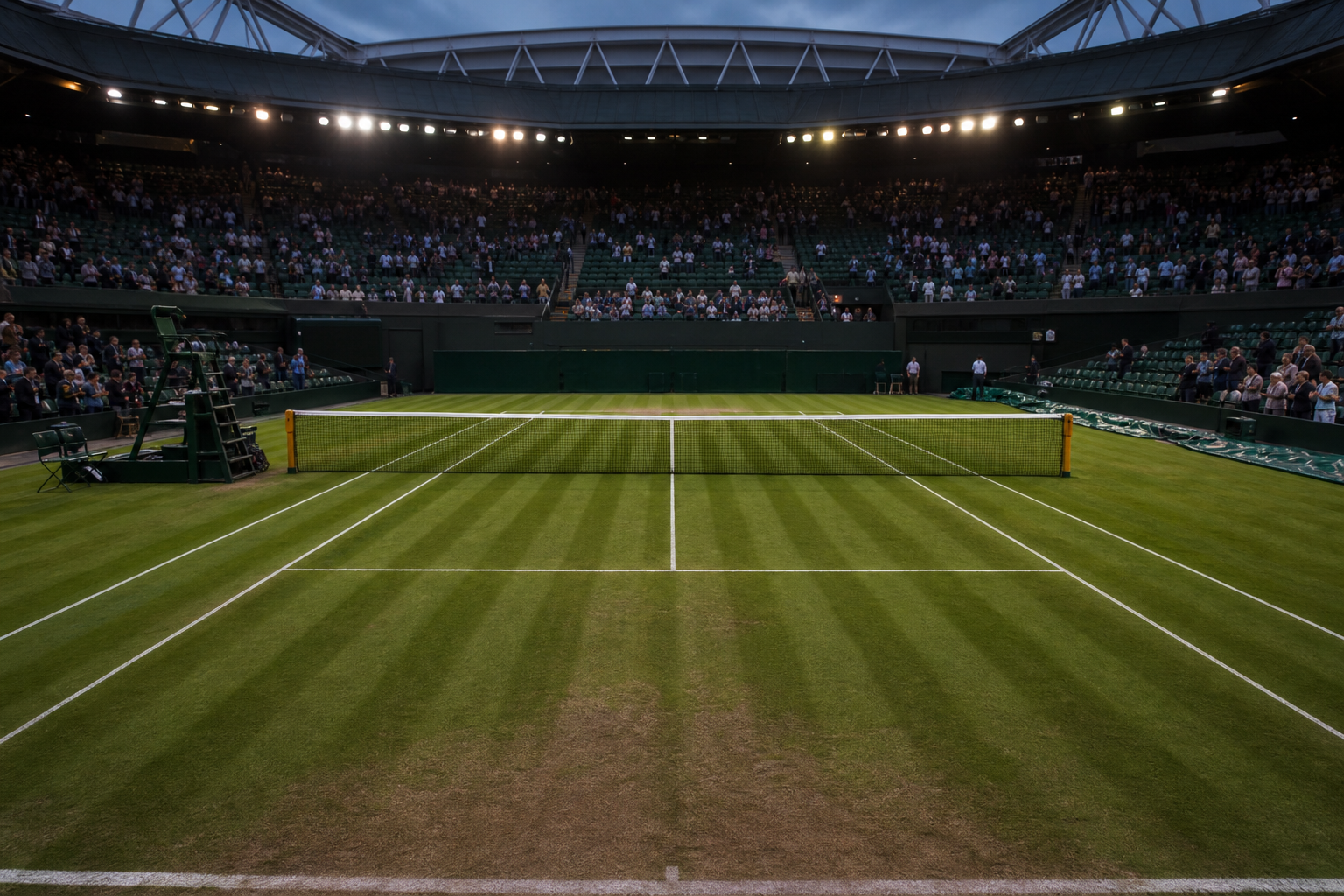
Wimbledon, Court 17 – What began as an open contest between two qualifiers evolved into one of the most emotionally charged matches of the second round. Michael Zheng defeated Nicolás Mejía 7:6, 6:7, 1:6, 4:6, adding another chapter to his remarkable rise through the ranks.
Mejía fights his way into the first set
Nicolás Mejía, Colombia's number one and only recently qualified for his first Grand Slam main draw, showed from the outset that he belongs on the sport's biggest grass courts. With a solid first-serve percentage of 65 percent and an unforced error count that remained manageable early on, the Colombian made life difficult for Zheng. The first set had to be settled in a tiebreak – Zheng kept his nerve to win it 7-4 and edged ahead.
Mejía refused to be rattled. In the second set he raised his return game and forced Zheng into a series of tight rallies. Once again the set went to a tiebreak – and it was here that the match produced its most dramatic moment.
The key moment: a winner while falling
Mejía led 6-4 in the second-set tiebreak and held two set points – a potential 2-0 set lead seemed within his grasp. Then the unthinkable: Zheng slipped on the grass while tracking down a drop shot, fell to the ground, and played a volley winner with his racket fully extended as he hit the turf. The shot saved the point, shattered Mejía's rhythm – and ultimately cost him the set. At 9-8 Zheng converted his third set point to win it 10-8 and level the match at one set apiece.
That moment was more than a spectacular individual point. It visibly shifted the psychological balance of the match. While Mejía was clearly unsettled by the missed set points, Zheng played with growing confidence. The third and fourth sets went comfortably to the American: 6-1 and 6-4.
Zheng's serve as his trump card
The statistics underline just how dominant Zheng was after the turning point. With 20 aces and a 100 percent hold rate on his service games, he gave Mejía virtually nothing to work with on return – the Colombian won just 19 percent of return games. Zheng's 58 winners against 31 unforced errors is a compelling tally on a demanding grass surface.
Mejía, meanwhile, was completely shut out on break points: a conversion rate of zero percent. That means he held serve in 81 percent of his own service games yet was never able to land the decisive break that might have turned the match around.
A career-best result for the Ivy League graduate
For Michael Zheng, the victory means far more than just another win in his still-young professional career. The 22-year-old from New Jersey, who completed his degree at the prestigious Columbia University in May 2026 and turned professional as a two-time NCAA singles champion, has reached the third round of a Grand Slam for the first time. In the previous round he had already beaten seeded Cameron Norrie in a fifth-set match tiebreak.
Mejía, meanwhile, leaves Wimbledon with mixed emotions: his Grand Slam debut ended in the second round, yet the Colombian proved he is capable of competing at this level. The missed set point in the second set remains the defining moment of the match – and, in all likelihood, one that will stay with him for some time to come.