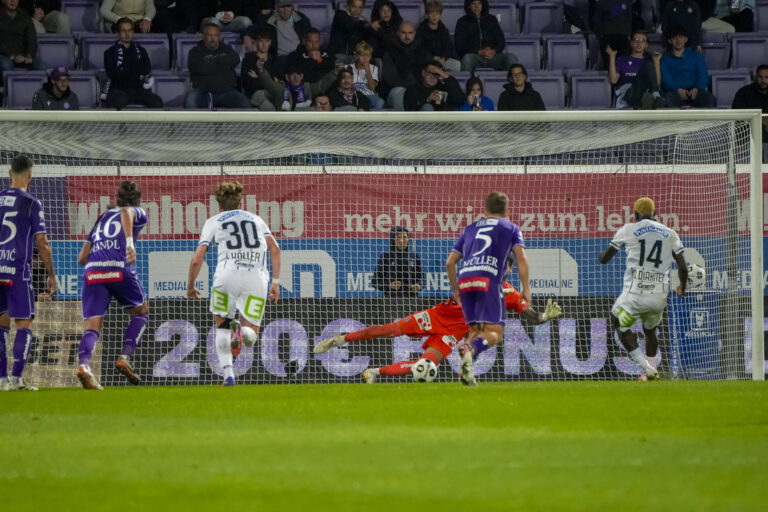
Oumar Diakité was the standout performer with a hat-trick. The margin of victory was emphatic and fully deserved, although the expected-goals numbers suggest Sturm were even more clinical than the final scoreline might imply.
Injury-hit Sturm forced to reshuffle again
Fabio Ingolitsch once more had to improvise. Otar Kiteishvili, Seedy Jatta, Nelson Weiper, Filip Rózga, Emran Soglo and Gizo Mamageishvili were all still unavailable. Sturm lined up in a 3-4-2-1 with Diakité through the middle, Simon Seidl and Valmir Matoshi operating behind him, and Jürgen Heil and Luís Balbo providing width.
GAK mirrored that basic structure. Gerald Scheiblehner’s side looked to play directly towards Hofleitner after regaining possession, with Italiano and Lichtenberger pushing up in support. Sturm, meanwhile, tried to find Seidl and Matoshi between the lines and stretch GAK’s back five through their advanced wide players.
The opening stages were evenly balanced. GAK defended aggressively, disrupted Sturm’s build-up and made the most of their first dangerous attack in the tenth minute. After a scrappy situation inside the penalty area, Cvetko reacted to Yannick Oberleitner’s set-up and finished on the half-volley for 1-0. The lead was more a reflection of GAK’s efficiency than any clear superiority. Diakité almost equalised immediately afterwards, only to be denied by Cican Stanković.
Khudyakov injury brings the game to a standstill
After just over 20 minutes, football suddenly became secondary. Italiano reached the ball first in a challenge but then caught Khudyakov heavily around the right ankle. The goalkeeper stayed down immediately. Players from both teams gathered around the medical staff, while the previously noisy stadium fell almost completely silent.
Khudyakov required lengthy treatment before being carried off on a stretcher. Ammar Helac replaced him in the 28th minute. The images raised fears of a serious injury to the right lower leg.
Sturm recovered quickly from the lengthy interruption and began to increase the pressure. Their counterpressing in particular became far more effective. GAK were given almost no time after winning the ball, while Sturm picked up second balls more consistently and attacked quickly from there.
Three goals in four minutes turn the derby around
The equaliser arrived in the 37th minute. Matoshi laid the ball off to Luca Weinhandl, who was afforded space outside the box and struck left-footed to make it 1-1. Sturm immediately kept the pressure on and needed only two more minutes to complete the turnaround. After a quick attack, Balbo found Heil, who finished the move for 2-1.
GAK’s previously compact structure suddenly began to fall apart. The distances between midfield and defence became too large, the wide players struggled to recover after turnovers and the back three were repeatedly forced to defend big spaces. Sturm recognised those problems immediately and attacked vertically as soon as possession changed hands.
The third goal followed in the 41st minute. GAK failed to clear another dangerous situation inside their own box and Diakité was on hand centrally to make it 3-1. In the space of just four minutes, Sturm had transformed a deficit into a commanding lead. It could have been even worse before the break, but further goals from Diakité and Quarshie were ruled out for offside.
Diakité completes his hat-trick after the break
Scheiblehner reacted at half-time by introducing Mark Grosse and Tim Trummer, but the changes did little to stabilise GAK. Sturm simply picked up where they had left off, with Seidl continuing to find space behind the visiting midfield.
In the 49th minute, Seidl slipped Diakité into the box and the striker exploited another opening to score his second. Just two minutes later, the same combination struck again. Seidl found Diakité once more, and the Ivorian finished to complete his hat-trick and make it 5-1. He needed only four shots for his three goals and punished GAK’s defensive mistakes with ruthless efficiency.
Sturm’s dominance was not simply the result of individual errors. The constant movement around Seidl and Diakité repeatedly pulled GAK defenders out of position, while the visitors struggled to relieve the pressure whenever they recovered the ball.
After an hour, Ingolitsch withdrew Diakité, Quarshie and Balbo together. The tempo dropped somewhat from there, but Sturm still added a sixth in the 75th minute. Seidl delivered a corner into the box and Jon Gorenc Stanković rose above the defence to head home. It was already Seidl’s third assist of the second half.
Sturm punish GAK’s mistakes with ruthless efficiency
The scoreline was emphatic, although the possession split was far more even at 55 to 45 per cent. The decisive difference was what Sturm did after regaining the ball. The hosts finished with a 24-12 advantage in shots and 41-18 in touches inside the opposition penalty area. The expected-goals numbers also clearly favoured Sturm, 3.59 to 0.60.
Scoring six times from 3.59 xG underlines just how efficient Sturm were in front of goal. Even so, the victory itself was fully deserved given their clear superiority in shooting volume and dangerous box entries. Once Sturm had equalised, GAK could no longer cope with the hosts’ quick transitions, Diakité’s movement or Seidl’s positioning between the lines.
Gorenc Stanković won more than 80 per cent of his duels and provided stability in midfield, while Seidl shaped the second half with three assists. GAK, by contrast, were unable to build on their promising start and lost control of the game within minutes after the equaliser.
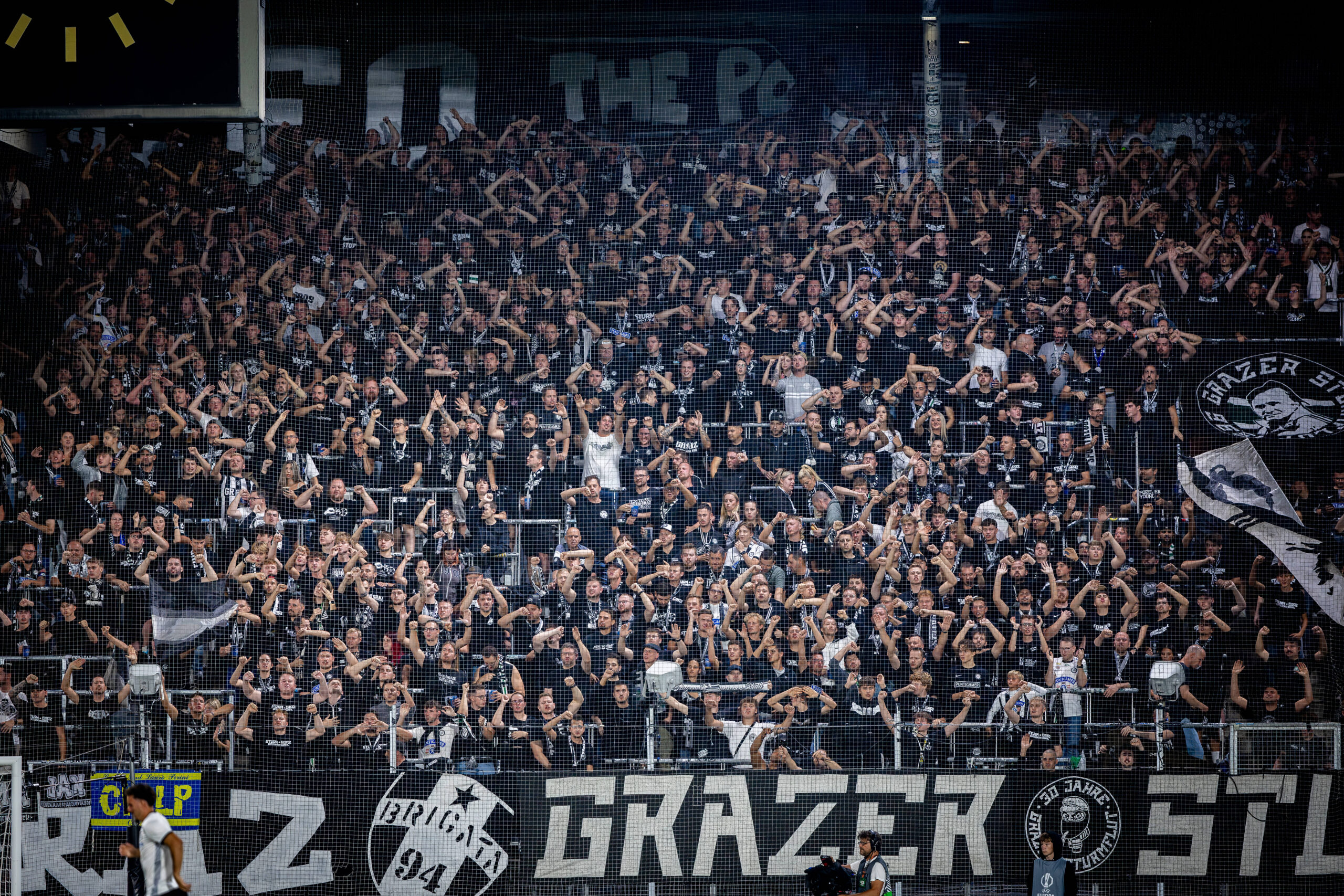
In front of a sold-out Liebenau Arena, Sturm produced an emphatic response to their 3-0 defeat in Bournemouth and remain within touching distance of the leading group on 17 points. For GAK, a run of four unbeaten Bundesliga matches came to a brutally abrupt end.