Until the sending-off, the contest had been far more even than the final scoreline suggests. Czechia troubled England with quick transitions and created dangerous openings of their own. Once reduced to ten men, however, the hosts were pushed increasingly deep and the game was played almost entirely in their half.
Tuchel reshuffles the defence as Bellingham starts on the bench
Tuchel made four changes following the 3-2 defeat to Spain. The most striking feature was the almost completely revamped back four, with Trent Alexander-Arnold, Trevoh Chalobah and Lewis Hall joining Marc Guéhi in defence. Nico O’Reilly was unavailable through injury, while Jude Bellingham started on the bench. Elliot Anderson and Myles Lewis-Skelly operated in central midfield, with Bukayo Saka, Morgan Rogers and Gordon supporting Kane.
Santi Denia also made several changes to the Czech side that had lost 2-1 to Croatia. Matěj Kovář started in goal, Ladislav Krejčí moved into defence and Matěj Radosta began on the right side of the attack. Czechia retained their basic 4-2-3-1 structure.
Czechia target England’s unfamiliar back line
The hosts’ approach worked well in the opening stages. Czechia did not simply sit deep, instead pressing loose passes in England’s build-up and looking to attack the space behind the newly assembled defence immediately after turnovers.
Šulc almost broke through after only five minutes following a long ball and a misjudgement from Anderson, but James Trafford came off his line in time. Šulc soon found space outside the penalty area again but hesitated too long, while Lukáš Červ also sent a volley narrowly wide.
England had more of the ball but initially struggled to get their attacking players into promising positions. Their best combination came through Gordon, who cut the ball back from the left for Rogers. His shot on the turn struck the post.
Šulc’s red card transforms the balance of the game
The contest changed fundamentally in the 24th minute. Šulc arrived late on Anderson and caught the England midfielder above the ankle with his studs showing. Referee Halil Umut Meler initially produced a yellow card, but upgraded it to red following a VAR intervention and an on-field review.
The numbers illustrate how dramatically the game changed. Before the sending-off, England had registered four shots and Czechia three, showing that the hosts were doing far more than simply defending. Over the remaining 65 minutes or so, the shot count was 18-3 in England’s favour.
Czechia were forced into a deep defensive block, crowding the central areas and trying to steer England towards the flanks. Hložek remained the main outlet further forward. England now dominated possession almost completely but still found it difficult to break down the compact ten-man defence before half-time. Kane forced Kovář into a save shortly before the interval, but clear chances remained scarce.
Tuchel’s half-time adjustment delivers an immediate breakthrough
Tuchel responded at the break by replacing the already-booked Lewis-Skelly with Eberechi Eze. England occupied the attacking spaces more aggressively, while Alexander-Arnold and Hall pushed significantly higher down the flanks.
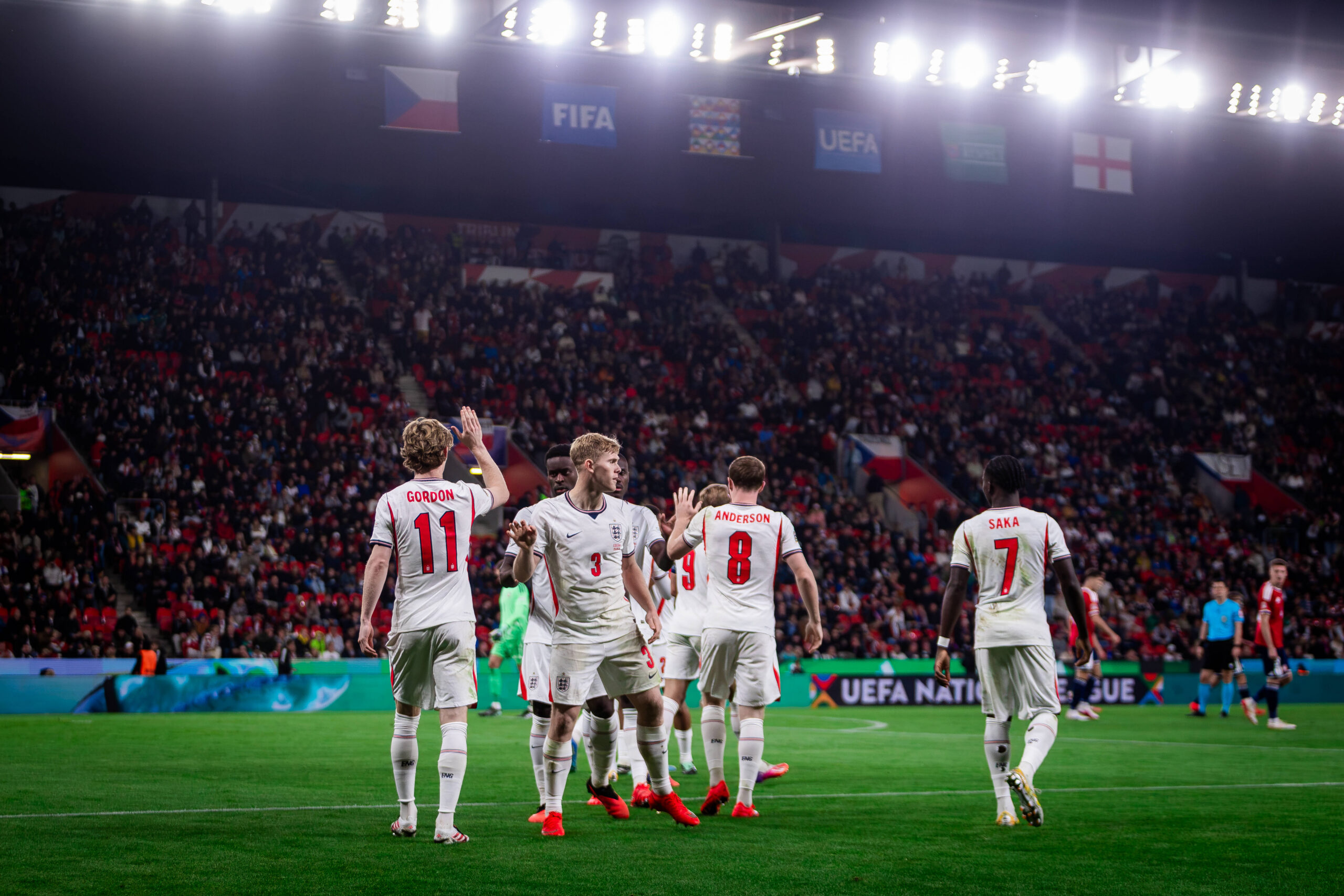
The effect was immediate. In the 47th minute, England regained possession on the right. Alexander-Arnold had time to deliver an accurate cross towards the far post, where Gordon escaped his marker and headed home for 1-0.
England played with greater fluency after taking the lead. The visitors used the full width of the pitch more effectively and forced the Czech defensive block into longer lateral movements. One dangerous Hall cross was later turned against his own post by Krejčí.
Gordon continued his strong form with four shots of his own and four chances created. His runs from the left into the penalty area were particularly difficult for the increasingly tired Czech defence to track.
Kane puts the result beyond doubt
The second goal arrived in the 69th minute. Rogers drove into the penalty area, Krejčí was unable to deal cleanly with the situation and Kane reacted quickest to the loose ball. The captain collected it and calmly finished left-footed into the far corner. It was his 87th goal for England.
The game was effectively over from that point. Czechia struggled to mount any meaningful counter-attacks, while England retained control with the help of fresh legs. Alex Scott and Rio Ngumoha made their competitive international debuts, while Bellingham was also given minutes from the bench.
Alexander-Arnold was another influential figure. Alongside his assist, he produced three key passes and delivered nine crosses. Particularly after half-time, England made much better use of his passing and crossing quality from the right.
England find the right solutions after the break
England finished with 66 per cent possession, a 22-6 advantage in shots and 1.48 xG compared to Czechia’s 0.32. Given the lengthy numerical advantage, the victory was deserved, although the hosts had shown before the red card that their direct transitions could cause England problems.
The most encouraging aspect for Tuchel was the response after half-time. England used the width more effectively, moved the ball quicker and eventually made their extra man count. After the 3-2 defeat to Spain, they now have their first three points of the Nations League campaign.
England travel to Croatia on Saturday for their next assignment, where they are likely to face a considerably tougher test.