Bendegúz Bolla gave Rapid the lead from the penalty spot as early as the fifth minute. Daniel Luts equalised shortly before half-time, before substitutes Moulaye Haidara and Petter Dahl decided the match in the closing stages. Haidara scored twice and completed the final score in stoppage time.
Early lead through Bolla
Rapid were given the opportunity to take the lead after only a few minutes. Victor Hugo handled the ball inside his own penalty area and, following a review, the referee awarded a penalty. Bolla assumed responsibility and sent a low shot into the right corner to make it 1-0.
The early goal should have given Rapid confidence. As expected, the visitors took control and pushed Paide deep into their own half. The Estonians defended in a low block, while Rapid moved their centre-backs high up the pitch and were able to build their attacks almost undisturbed for long periods.
However, their territorial superiority produced too little. Rapid particularly lacked verticality when trying to progress from the middle third into the final third. The ball was frequently passed sideways between the centre-backs, full-backs and midfielders dropping deep. Paide’s compact block therefore rarely had to cover greater distances.
Rapid did not attempt enough quick passes between the lines. Switches of play towards the far side were also in short supply. As a result, the hosts were able to maintain their shape and repeatedly force Rapid towards the flanks. The Vienna side had plenty of possession but generated very little momentum from it.
Paide punish Rapid’s passivity
Tobias Gulliksen and Tonni Adamsen tried their luck from distance, while Marco Tilio reached shooting positions after crosses. None of these efforts were particularly threatening. Rapid played neatly until they approached the opposition penalty area but rarely found clear solutions once they got there.
Paide also offered relatively little going forward, although they posed a threat from set pieces and occasional transitions. In the 41st minute, Rapid failed to clear the ball following a corner. A header from Abdourahman Badamosi was initially blocked, but Daniel Luts reacted quickest and scored from close range to make it 1-1.
The equaliser had not come completely out of nowhere. Paide had already forced several set-piece situations and created another opportunity through Badamosi shortly after the goal. Niklas Hedl prevented Rapid from going into the break behind.
Rapid remain short of ideas after the break
The basic pattern of the match initially remained unchanged. Rapid had the ball, while Paide defended deep. However, the visitors continued to play too slowly and statically. Nikolaus Wurmbrand tested Ebrima Jarju from distance, while further attempts from Tilio and Gulliksen were either harmless or blocked.
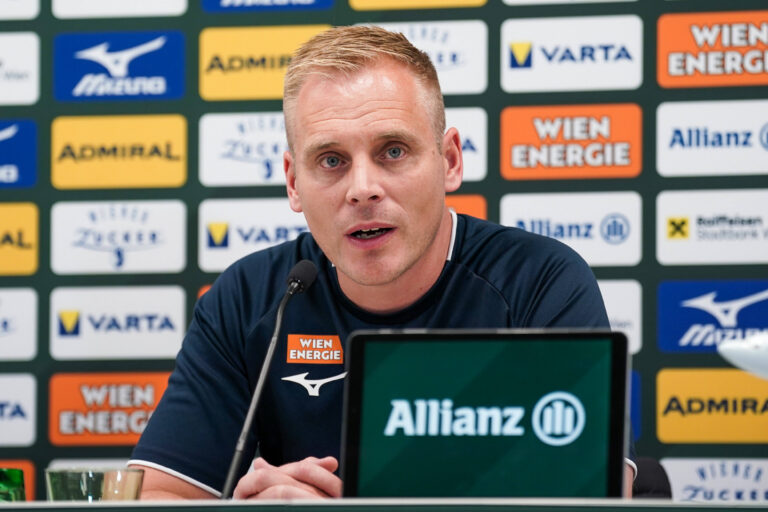
Coach Johannes Hoff Thorup initially responded by bringing Dahl on for Tilio. A triple substitution followed in the 69th minute, when Yusuf Demir, Moulaye Haidara and Nicolas Bajlicz replaced Gulliksen, Wurmbrand and Schaub.
Demir and Haidara in particular changed Rapid’s attacking play. Demir immediately looked for one-on-one situations, moved inside more frequently and accelerated the game with his close control. Haidara added more runs in behind, presence and determination inside the penalty area. Rapid were no longer merely playing around Paide’s defensive block but began attacking the last line much more directly.
Demir had an effort only a few minutes after coming on but was denied by Jarju. At the other end, Paide remained dangerous on the counterattack. Pa Modou Sohna fired narrowly wide following a quick break. At that stage, Rapid had by no means decided the match.
Three goals during the Rapid quarter-hour
Paide even had an opportunity to take the lead in the 82nd minute. Substitute Henri Anier met a corner with a close-range header but directed the ball over the goal. Rapid then struck almost immediately at the other end.
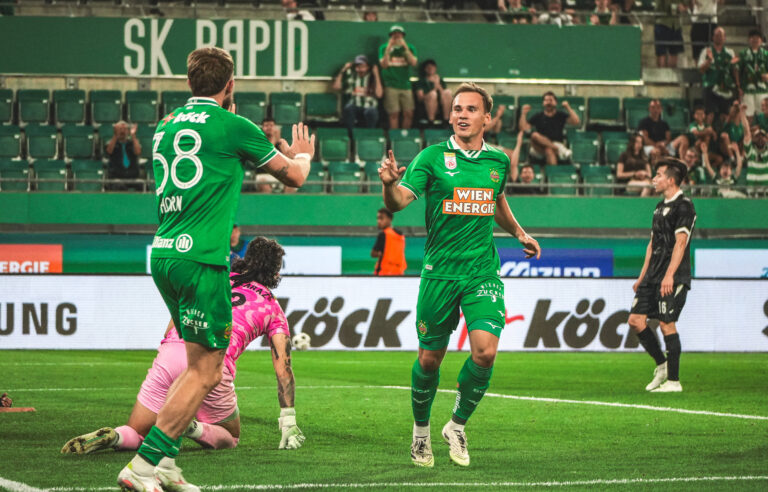
Haidara found space in a central position and scored with a low finish in the 83rd minute to make it 2-1. The decisive third goal followed only two minutes later. Bolla delivered the ball into the penalty area from the right and Dahl converted from close range.
That finally broke the resistance of the Estonian underdogs, who began making more and more mistakes. Demir remained lively, registered further attempts and continued to cause problems. Haidara added the final goal in the fourth minute of stoppage time. Adamsen released the forward with an elegant pass in behind, and Haidara calmly finished to make it 4-1.
The result was better than the performance
The statistics underline Rapid’s clear territorial superiority. The Vienna side had 74 per cent possession, attempted 14 shots and recorded 32 touches inside the opposition penalty area. Paide managed seven attempts and 14 touches in the box.
However, the expected-goals figures put the emphatic result into perspective. Rapid recorded 1.97 xG, while Paide reached 1.27. The hosts therefore created some useful opportunities from their limited attacking play. For much of the match, the difference between the teams was nowhere near as large as the final score suggests.
Rapid completed their task and established an excellent position ahead of the second leg. Nevertheless, this was not a good performance. Too much possession remained ineffective, while their attacking play lacked tempo, verticality and switches of play for long periods. Only the substitutions, particularly the introductions of Demir and Haidara, provided the necessary drive towards goal.
Following the 4-1 victory, qualification should now be little more than a formality ahead of the second leg in Hütteldorf on Wednesday, 12 August, at 6 p.m. Rapid avoided embarrassment late on, but the performance will have to be assessed much more critically internally than the result.