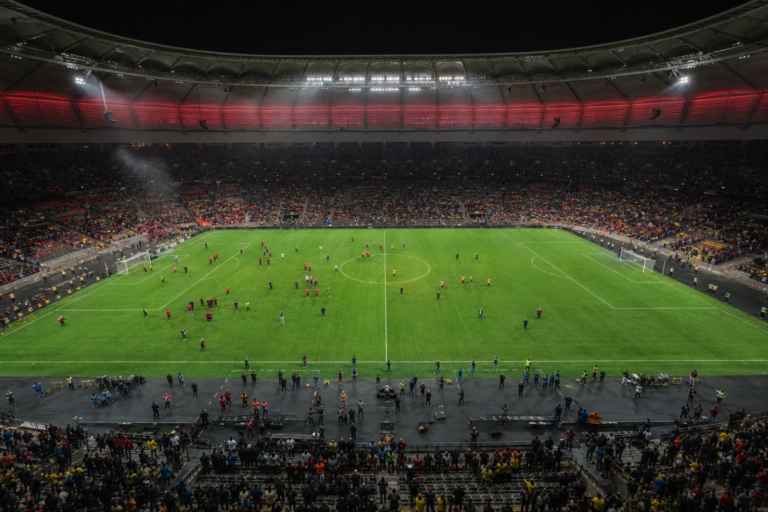
On paper, however, plenty points towards Rapid. Since a 3-0 home defeat in December 2020, the Green-Whites have not lost a Bundesliga meeting with WSG. Their home form has been particularly impressive this season: Rapid have won all three league games at the Allianz Stadion, with a goal difference of 12-1.
Rapid are finding more and more solutions in possession
The biggest difference compared with last season is not just the results. Rapid look far more stable on the ball and are now able to progress into the final third in several different ways. The midfield pairing of Matthias Seidl and Nicolas Bajlicz has worked remarkably well despite the relatively limited depth in central areas.
Bajlicz in particular has become important because of his ability to receive on the turn and carry the ball through opposition pressure. At the same time, Seidl has regained confidence after a more difficult spell. That combination helps Rapid avoid relying exclusively on wide attacks and allows them to progress through the half-spaces in a much more controlled way.
Further forward, Yusuf Demir is enjoying one of his strongest spells in a Rapid shirt. The 23-year-old is combining his technical qualities with much greater intensity without the ball. He has two goals and two assists in the league and ranks among the competition’s standout players in several creative attacking metrics.
Rapid also have far more variety in the final third. Tonni Adamsen leads the club’s scoring charts with four goals, while Petter Nosa Dahl has three. Marco Tilio, Ercan Kara, Nikolaus Wurmbrand, Moulaye Haidara and the recently returned Claudy Mbuyi all offer different profiles.
Adamsen’s movement could trouble WSG
Adamsen is one of Rapid’s key tactical figures. Although nominally an attacking player, the Dane regularly drops into the space between the lines or drifts towards the flanks.
That creates difficult decisions for opposing defenders. If they follow him, space opens up behind the last line; if they stay deep, Rapid can create overloads around the No.10 zone.
Those are precisely the areas WSG will need to control. Philipp Semlic generally sets his side up in a 4-2-3-1 that becomes compact without the ball before looking to transition quickly. Rapid are likely to dominate possession, but must avoid becoming too static in front of the Tirol defence.
WSG have already shown that they can trouble stronger opponents. They began with a 1-1 draw against Sturm Graz, followed by defeats to Altach and Salzburg, but then recorded two eye-catching away wins: 4-0 against Austria Lustenau and 1-0 at Austria Wien. Most recently, they came back from 2-0 down to draw 2-2 with Hartberg.
WSG squad offers far more options
That WSG have looked so stable despite losing key players such as Adam Stejskal, Valentino Müller and Jamie Lawrence is also down to smart squad planning. Salko Hamzić has immediately established himself as a reliable No.1, while the defence around Marco Boras, David Gugganig and Drew Murray has generally performed well.
The midfield mix is especially interesting. Marc Striednig has quickly become an important figure, Matthäus Taferner stayed at the club and experienced options such as Thomas Goiginger, Nemanja Celic and Murat Satin give Semlic additional depth. The loan signing of Moritz Oswald also adds tactical flexibility, as the Rapid player can operate centrally or at either full-back position.
The attacking options are even more notable. Michael Olakigbe provides pace and depth, Husein Balić brings Bundesliga experience, while Moritz Wels can now even be introduced from the bench. The draw with Hartberg illustrated exactly what that depth can mean: Lukas Hinterseer scored after coming on, Thomas Sabitzer won the late penalty and fellow substitute Satin converted for 2-2.
Olakigbe and Nikolai Baden Frederiksen lead WSG’s scoring charts with two goals each. Overall, the Tirol side have scored nine goals in six rounds – although they have also conceded nine.
Rapid must justify their status as favourites
WSG travel to Vienna with almost a full squad available. Only long-term absentee Quincy Butler is unavailable, giving Semlic several options to change the game from the bench.
Rapid nevertheless go into the match as clear favourites. That is based not only on their strong head-to-head record, but also on the performances they have produced at home so far. Altach were beaten 1-0, GAK were swept aside 8-0 and Sturm lost 3-1 in Hütteldorf. Rapid’s only league defeat came in a 5-1 loss at Salzburg, to which they responded with an impressive 3-0 away win against WAC.
That is what makes the WSG game an interesting test. Rapid have repeatedly struggled in recent years when they were expected to control matches against opponents who defended deep and denied space. So far this season, Thorup’s side have looked much better equipped to handle exactly those situations.
WSG, meanwhile, can approach the game with relatively little pressure. Eight points from six matches have given them a comfortable platform, and taking something from Hütteldorf would further underline their strong start. For Rapid, a fourth home win would be further evidence that their new-found stability can work not only against stronger opposition, but also against compact underdogs.