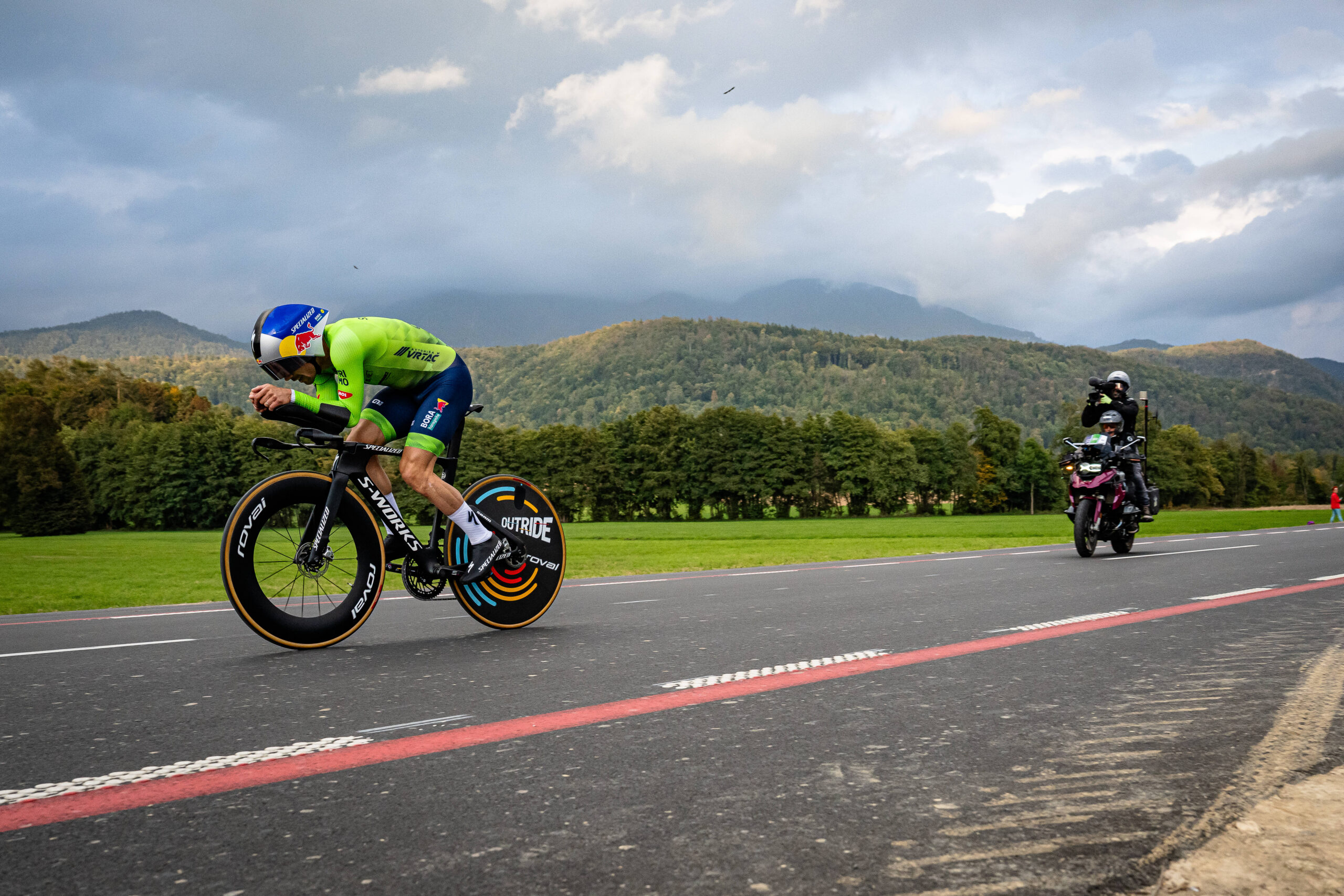
After 22 kilometres, Roglič finished 6.58 seconds ahead of France’s Bruno Armirail. Armirail’s compatriot Maxime Decomble completed the podium, just under 29 seconds behind the winner. For Slovenia, it was the first medal of the home championships in the elite events – and it came in the final race, in gold.
Roglič lays the foundations on the Možjanca climb
The course was far more demanding than a conventional flat time trial. Its defining feature was the roughly two-kilometre climb to Možjanca, which averaged around ten per cent. It was there that Roglič was able to make the difference.
At the first intermediate checkpoint after eight kilometres, the Slovenian was already in front and had built a lead of around 13 seconds over Armirail. A fast descent and a considerably flatter second half of the course followed. Armirail managed to claw back some time, but Roglič held enough of an advantage to secure victory.
Roglič stopped the clock at 28:16.61, producing an average speed of 46.68 km/h. Given the profile, it was an impressive figure. Unlike on a completely flat course, the challenge was not only about aerodynamics and sustaining constant power, but also about pacing the steep climb correctly and transitioning efficiently into the faster sections.
Radio fails after just one kilometre
The victory was all the more notable because Roglič completed most of the race without a functioning radio connection. Contact with the team car was lost after roughly the first kilometre, leaving him without information on intermediate times, gaps or his advantage over the competition.
After the race, Roglič explained that he had barely known where he stood compared with his rivals and had therefore focused entirely on his own rhythm. He said he had simply tried to leave everything out on the road – and in the end, it was just enough for gold.
On a time trial course with such contrasting sections, that lack of information was far from insignificant. Going too deep on the climb could easily have cost valuable time in the faster finale. Roglič nevertheless managed his effort almost perfectly.
Emotional triumph in front of the home crowd
The victory carried additional significance because the European Championships were being held in Slovenia. Large numbers of home fans lined the course, with particularly strong support around the Možjanca climb.
The pressure on the hosts had steadily increased as the championships progressed. Slovenia had gone without a medal in the first 13 events. Tadej Pogačar was absent due to the effects of his crash at the Vuelta, while Roglič had finished tenth in the road race a few days earlier. The concluding time trial therefore represented the country’s final major opportunity for success on home roads.
Afterwards, Roglič said victories in Slovenia had been rare for him and that he would probably remember this day for the rest of his life. Hearing the Slovenian national anthem during the podium ceremony was an especially emotional moment.
Ten years on from his first major time trial victory
The European title also provides a fitting link to an earlier chapter of Roglič’s career. Exactly ten years ago, he claimed one of his first major professional victories in the demanding Chianti time trial at the 2016 Giro d’Italia. On that hilly course, the former ski jumper surprised more established specialists and offered an early glimpse of the time-trial ability he would later develop.
Roglič’s biggest success against the clock remains his Olympic title from Tokyo in 2021. On that occasion, he won gold by more than a minute from Tom Dumoulin. The European title now adds another major championship honour in the discipline.
The circumstances of his 2026 season make the achievement even more significant. During the summer, Roglič was hit by a car while training and had to alter parts of his preparation for the Vuelta a España. Even so, he finished the race second behind Enric Mas. Just a few weeks later, he has now followed that up with a European title in front of his home crowd.
At 36, Roglič once again demonstrated that he remains capable of competing at the very highest level. The demanding course, the narrow margin of victory and the emotion of racing at home combine to make this European title one of the more memorable successes of his long career.