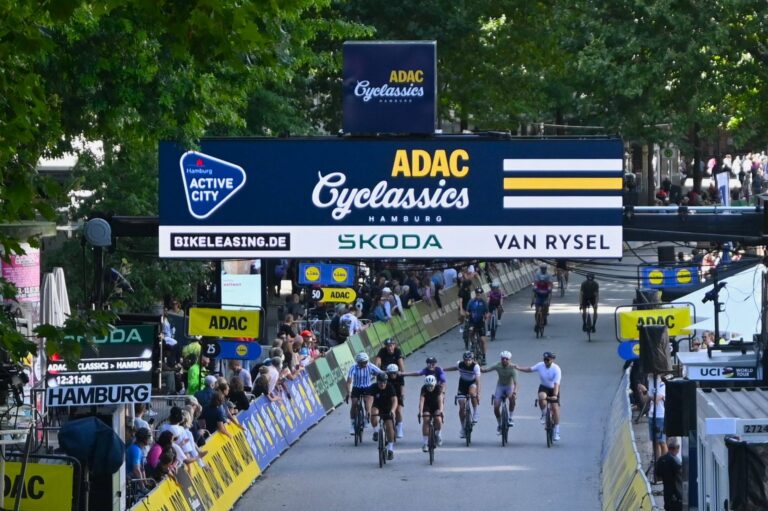
After 205.3 kilometres and 4:17:55 of racing, Magnier was able to celebrate victory on Hamburg’s Mönckebergstraße. It was another major success in an already impressive season for the Soudal Quick-Step rider, who had previously won three stages at the Giro d’Italia. The Frenchman had finished third at the Cyclassics last year.
Six-man breakaway shapes much of the race
As in 2025, an early breakaway dictated much of the action. Jonas Rutsch, Benjamin Thomas, Dries de Pooter, Niklas Behrens, Loe van Belle and Filip Maciejuk escaped from the peloton early on and at one stage built an advantage of more than four minutes.
Last year, Rory Townsend had sprung a surprise with a successful breakaway victory, but this time the sprinters’ teams made sure they were not caught out. The five passages over the short but steep Waseberg increasingly split the field as the race progressed.
On the final ascent, Rutsch and Thomas managed to distance Behrens and van Belle once more. By then, however, the chances of another breakaway victory were already fading. Shortly after the summit, with around 15 kilometres remaining, the escape was finally caught by the first chasing group.
Milan and Kooij miss the decisive group
The repeated climbs had already significantly reduced the field. Two of the most highly rated sprinters before the race, Jonathan Milan and Olav Kooij, were missing from the decisive front group.
With several teams maintaining a high pace at the front, the dropped riders were unable to make their way back over the remaining flat kilometres. Soudal Quick-Step in particular had every reason to keep their rivals at a distance and bring Magnier into the finale in the best possible position.
Isaac del Toro also tried to make the race more aggressive. The Mexican, who had finished third overall at the Tour de France at the end of July, attacked in the finale but was unable to open a decisive gap on the flat terrain towards central Hamburg.
It had already been an eventful afternoon for Del Toro. Earlier, he crashed while taking a feed bag but was quickly able to continue. There was a more serious incident earlier in the race when Michael Matthews was among the riders forced to abandon following a crash.
Magnier proves too strong in the sprint
Soudal Quick-Step initially put their leader in a good position for the finale. Magnier’s final helper was already spent before the sprint itself began, but the Frenchman still chose the right moment to launch his effort.
Laurence Pithie moved to the front with support from a teammate, but once Magnier opened his sprint he was unable to respond. The Frenchman pulled clear and crossed the line more than a bike length ahead.
Mike Teunissen took second place, with Pithie finishing third. Paul Penhoët followed in fourth, while Germany’s Henri Uhlig produced the best result by a home rider in fifth. Arnaud De Lie, runner-up last year, had to settle for tenth this time.
From an Austrian perspective, Marco Haller made it into the first large group and finished 26th. The 35-year-old has particularly fond memories of Hamburg: in 2022, he caused a major upset by winning the Cyclassics from a small breakaway group, beating Wout van Aert among others in the sprint.
Tragic death during the amateur race
The day of cycling was overshadowed by a fatal incident during the amateur race held earlier in the day, which featured around 12,000 participants. A 70-year-old rider came down on the course in the morning and required resuscitation at the scene. He was taken to hospital while CPR continued, but later died.
The exact cause of the incident was initially unclear. Police and fire services said that a medical emergency or pre-existing condition may have preceded the fall, while the organiser referred to the rider having suffered a sudden weakness.