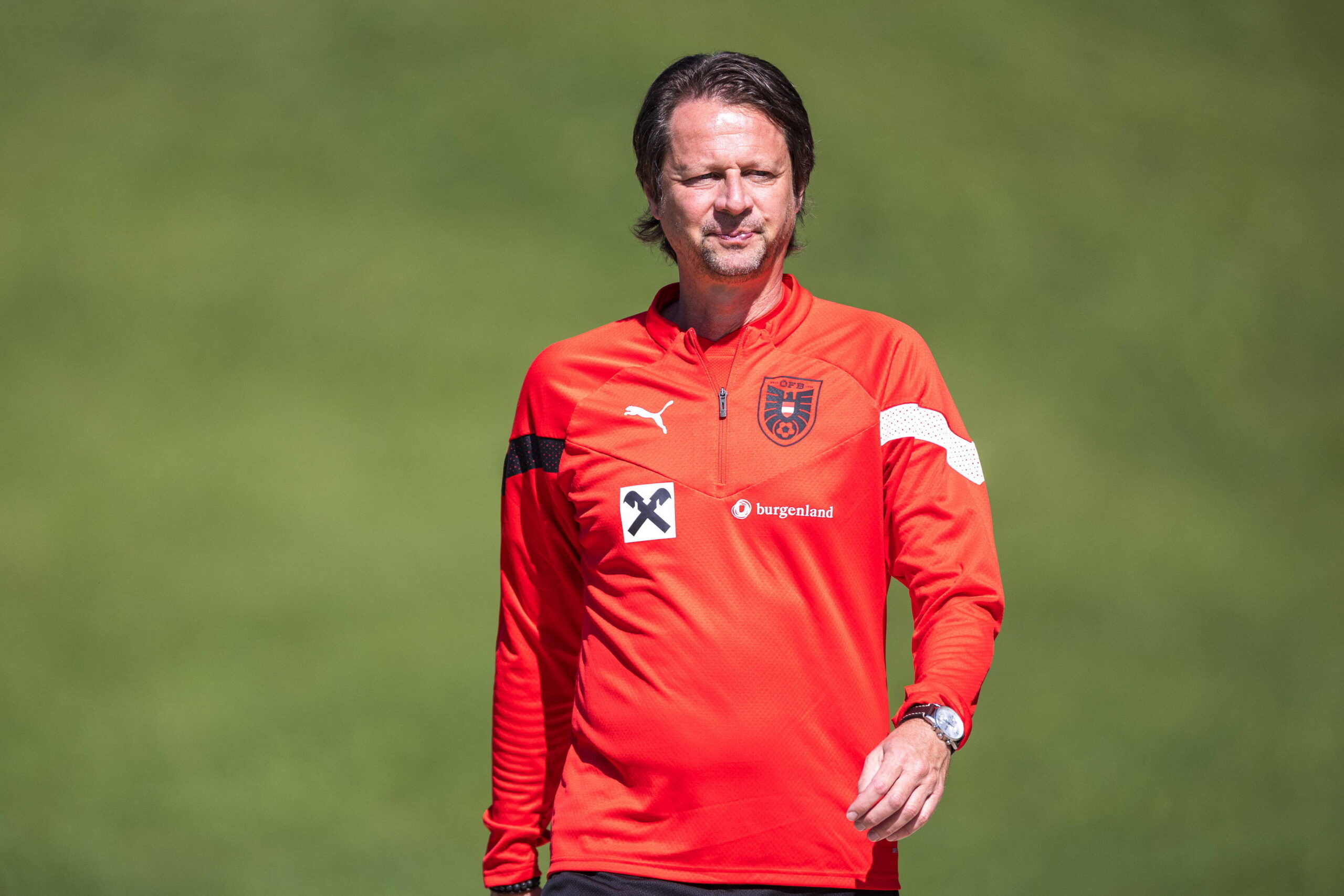
There has been no official confirmation so far that the 59-year-old is set to leave. However, the speculation has not emerged entirely out of the blue. Schöttel’s area of responsibility has changed noticeably in recent years, while several major sporting decisions have increasingly been shared across different figures within the association.
From Foda to Rangnick: Almost nine years in the job
Schöttel became sporting director in October 2017, succeeding Willi Ruttensteiner. One of the first major decisions during his tenure was the appointment of Franco Foda as Austria head coach. Under the German, the national team reached the knockout stage of a European Championship for the first time at Euro 2021, but subsequently failed to qualify for the 2022 World Cup.
Arguably the most important personnel decision of the Schöttel era followed in spring 2022. After Foda’s departure, the sporting director drew up a shortlist of possible successors before the opportunity arose to appoint Ralf Rangnick. Schöttel established contact with the former Salzburg sporting director and played a significant role in bringing the internationally renowned German to the ÖFB.
Austria’s style of play changed fundamentally under Rangnick. The national team impressed for long stretches at Euro 2024, won its group and later qualified for a World Cup for the first time since 1998. The appointment of Rangnick therefore remains one of the strongest points in Schöttel’s record.
Responsibilities have gradually shifted
At the same time, Schöttel’s position within the sporting structure has become less central. At the end of 2024, the ÖFB appointed Sebastian Prödl as sporting director of the youth national teams. The former Austria international, who won 73 caps, was handed responsibility for an area that had previously fallen more directly under Schöttel’s remit.
Rangnick’s influence has also extended far beyond his role as head coach of the senior national team. He has increasingly introduced his own ideas regarding structures and sporting development, giving him considerable influence over the federation’s overall direction.
That shift became particularly apparent during negotiations over Rangnick’s contract extension until 2028. The decisive talks were led primarily by Josef Pröll, chairman of the ÖFB supervisory board, who also personally announced the agreement with Rangnick in June. For a sporting director, it is at least unusual not to be perceived as a central figure in such a significant personnel decision.
Friday could bring clarity
It is against this backdrop that the latest speculation gains additional significance. Several Austrian media outlets are now reporting that Schöttel’s tenure could be approaching its end. Friday’s scheduled meeting is being viewed as a possible occasion for the federation to discuss its sporting structures and, with them, Schöttel’s position.
For now, however, no decision has been made. Schöttel has continued to perform operational duties throughout 2026, including involvement with the women’s national team and the federation’s training camp for emerging players.
Should his almost nine-year spell actually come to an end, the ÖFB would have to do more than simply appoint a new sporting director. It would also need to define how responsibilities are divided in future between Rangnick, Prödl and any new sporting leadership. Given the head coach’s growing influence, the possible personnel change could therefore have consequences that extend well beyond Peter Schöttel’s own future.