David Alaba, Marko Arnautovic and Marcel Sabitzer are all absent, meaning Austria are without three long-standing leaders. Alaba is currently not match fit, Arnautovic retired from international football after the World Cup, while Sabitzer has stepped away from national-team duty until at least the end of the year. Konrad Laimer, who would have been one of the leading candidates to wear the armband in this new setup, is also unavailable for at least the matches against Israel and Kosovo because of an adductor injury.
Gregoritsch named captain – but not for every game
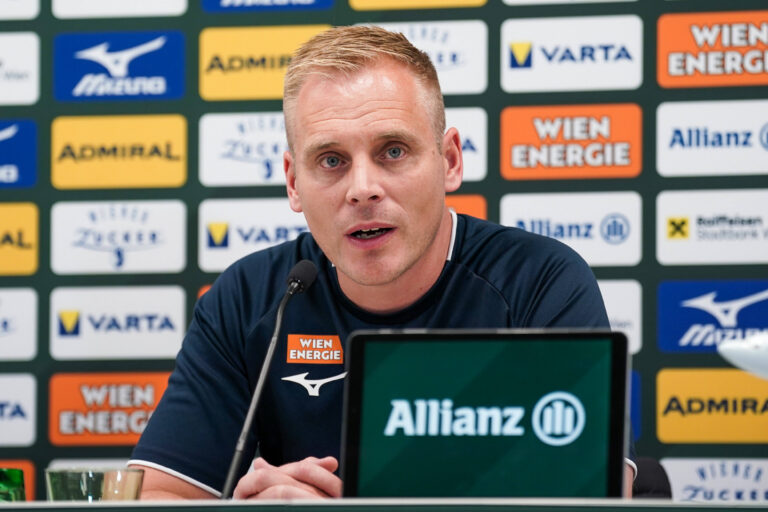
Rangnick explained that Gregoritsch’s experience and personality were decisive factors behind the choice. With 78 senior caps, the striker is comfortably the most experienced player in the current squad.
However, the head coach also suggested that the armband could change hands during this international window: “I don’t think Gregerl is going to play all four games from start to finish. That’s unlikely. So it’s quite possible that someone else will wear the armband in one of the other matches.”
That immediately raises the question of how Austria’s new leadership group will be structured. Rangnick did not name a fixed deputy. Xaver Schlager would be an obvious candidate given his experience, importance in central midfield and personality. Goalkeeper Alexander Schlager is another player who has been part of Rangnick’s core group for some time.
At the back, Philipp Lienhart and Maximilian Wöber are further possibilities. Both have been established internationals for several years and bring considerable experience at club and international level. Should Laimer recover later in the window, the Bayern midfielder would immediately become another logical candidate.
Rangnick, however, wants responsibility to be spread throughout the team. For his style of football, he stressed that “every player on the pitch has to take responsibility”. Given the “swarm intelligence” he demands from his side, leadership cannot be restricted to one or two individuals.
Alexander Schlager remains number one for now
The situation in goal is more straightforward in the short term. Rangnick confirmed that Alexander Schlager will start against Israel. That is noteworthy because the 30-year-old has lost his starting place at club level following his summer move from Salzburg to Werder Bremen.
Werder signed Schlager after the World Cup but have continued to rely on Karl Hein as their first-choice goalkeeper. The Estonia international now officially wears the number-one shirt, while Schlager has number 30. The Austrian has featured in the DFB-Pokal, but in the Bundesliga he has so far had to settle for a place on the bench behind Hein.
Rangnick does not currently view that as a major issue: “He has still played in the cup for Bremen and before that he had a really good World Cup with us. That’s why I can confirm that he will start tomorrow.” However, the coach immediately added: “As a long-term solution, we’ll have to see what that means.”
That caveat makes Austria’s goalkeeper situation particularly interesting over the coming months.
Wiegele increasing the pressure
Florian Wiegele currently looks like the most serious challenger. The 25-year-old has a very different level of match rhythm at Viktoria Plzeň. The 2.05-metre goalkeeper has already made eight appearances in the Czech league this season and twice featured in European competition. He had already begun to establish himself more firmly at Plzeň during the previous campaign.
Wiegele was also part of Austria’s World Cup squad and has moved considerably closer to the senior team hierarchy. If Schlager continues to lack regular football at Werder, the pecking order could therefore change quickly. Rangnick explicitly referred to the principle of performance and also praised the impression made by the other goalkeepers in training.
Lukas Jungwirth and Christian Zawieschitzky are the two other young keepers in the squad. Both are regular starters at club level: Jungwirth is LASK’s number one, while Zawieschitzky has established himself at Salzburg at just 19.
For the immediate number-one debate, however, both are still outsiders. Their call-ups are also about introducing them to senior international level and increasing competition in training. The message to Schlager is nevertheless clear: he starts against Israel, but there is no long-term guarantee attached.